
The fog has settled thick over our little patch of western Hungary, the kind that makes the morning feel half-finished. Andrew and I are closing down the cottage for the season and preparing to migrate back to Budapest, where the Christmas markets are already in full swing. I’ve always loved this shift: leaving behind muddy boots and quiet evenings and stepping straight into mulled wine, bright lights, and my annual mission to taste every chimney cake within a reasonable radius.
As a Canadian-Hungarian, I grew up with these dishes, so nothing here is new to me. But eating Hungarian Christmas foods in Hungary has its own charm. Everything feels closer to the source – the smells, the rhythm of the season, the small traditions that never made it across the Atlantic in quite the same way.
Bejgli: Walnut, Poppy Seed, and the Annual Debate
Bejgli is the dependable anchor of Hungarian Christmas foods. Even people who claim not to like it will still eat it because it is simply expected to appear. The rolled pastry comes in two arguments disguised as fillings: walnut (dió) and poppy seed (mák). Everyone has a favourite, often inherited from a parent or grandmother.
I’ve eaten bejgli my whole life, and I still think walnut is the most elegant option. Poppy seed has its charm, but walnut tastes like childhood Christmases and feels less prone to leaving embarrassing evidence between your teeth. As Hungarian as this dish is, the quality varies wildly. Some supermarket versions are fine if you’re desperate, but a good bejgli has a smooth, generous filling and a neat, shiny crust.
This is also the point in December when people start discussing “cracks” on the top of the roll. No one wants them, everyone gets them, and families monitor them with the same vigilance normally reserved for bank accounts. It’s very Hungarian and very endearing.
Halászlé: The Festival Favourite I Still Can’t Get Behind
Halászlé is one of the most iconic Hungarian Christmas foods – a bright red, paprika-based fish soup that many families serve on Christmas Eve. People adore it with impressive conviction, and whole regions swear their version is the only proper one.
I respect the tradition completely. I simply do not eat it.
I didn’t grow up with halászlé, and even after years of living in Hungary, it remains one of the few festive dishes I politely decline. It has a devoted fanbase for good reason, but if you’re new to Hungary and wondering why an entire country becomes passionate about fish soup in December, just know that it’s deeply woven into the culture. Fortunately, Christmas offers plenty of alternatives for those of us who don’t join the halászlé crowd.
Töltött Káposzta: My Favourite Christmas Dish of All
If halászlé divides households, stuffed cabbage unites mine. Töltött káposzta has been my favourite Hungarian Christmas food since I was old enough to hold a fork. It was also my father’s favourite and a speciality of my grandmother, who made the kind of cabbage rolls that set the family standard for decades.
It’s a rich, slow-cooked dish made of cabbage leaves wrapped around seasoned rice and meat, nestled into a pot and left to develop over time. Hungarians will tell you it tastes even better the next day, and they’re right. It’s comforting, hearty, and unmistakably tied to winter.
Of course, opinions vary. I love it. Andrew does not. He has tried it multiple times, and every year the answer is still no. That said, he is very supportive of my enthusiasm, especially because it means there’s more for me.
Szaloncukor: The December Sport Andrew Takes Very Seriously
Szaloncukor is one of the easiest Hungarian Christmas foods to spot: individually wrapped, soft-centred sweets hung directly on the Christmas tree. It’s part decoration, part dessert, and part informal December snacking system. And in our household, Andrew treats it like a competitive seasonal event.
While I enjoy it, he approaches szaloncukor with the enthusiasm of someone completing a winter tasting circuit. Every year, Hungarian brands release new flavours and compete for the unofficial title of “best in show,” and supermarkets dedicate entire aisles to the line-up. Quality varies widely, which is half the fun.
We stock up early because the good flavours vanish by mid-December. I lean toward chocolate fillings, while Andrew works through the entire spectrum with cheerful commitment. By Christmas week, the tree always looks full from the front and suspiciously empty at the back.
Christmas Bakery Culture: Queues, Pre-Orders, and the Quiet Panic
Hungarian Christmas foods put bakeries under extraordinary pressure, and by early December you can feel the shift. People order their bejgli, zserbó, and Christmas pastries weeks in advance, then discuss their bakery pick-up strategy with the seriousness of a military exercise.
Quality ranges widely, but Budapest has an abundance of excellent options. Some people are Gerbeaud loyalists, others swear by Daubner, and every district has a few places with fierce neighbourhood followings.
I tend to keep things simple: I buy everything from Nándori Cukrászda. Their bejgli is consistently excellent, their pogácsa
is outstanding, and their Christmas pastries never feel mass-produced. They also run a pre-order system, which I appreciate. It keeps the chaos manageable. If you’re looking for classic Hungarian Christmas treats and cakes done properly, Nándori is a solid choice.
Hungarian Christmas Foods: FAQ
1. What are the essential Hungarian Christmas foods?
Hungarian Christmas foods usually include a mix of sweets and savoury dishes: bejgli (walnut or poppy seed roll), szaloncukor on the tree, zserbó, töltött káposzta, mákos guba, roasted meats, and winter pastries. Not every household serves the same thing, but these items appear consistently throughout December. Drinks usually include forralt bor (mulled wine) and forralt csoki (hot chocolate), both of which appear everywhere from markets to home kitchens.
2. Can you buy these foods at the Christmas markets?
Some of them, yes. You’ll find kürtőskalács, zserbó slices, mézeskalács, mulled wine (forralt bor), and hot chocolate (forralt csoki) at almost every market. Markets don’t usually sell full Christmas dishes like stuffed cabbage or whole bejgli rolls, but you can sample plenty of festive flavours while wandering.
3. What exactly is halászlé, and do all families serve it?
Halászlé is a bright red, paprika-based fish soup made from freshwater fish. Many Hungarian families serve it on Christmas Eve, but not all — it depends on household tradition. Some families never make it and prefer roasted meats or stuffed cabbage instead. If fish isn’t your thing, you won’t be alone.
4. What does a full Hungarian Christmas meal look like?
A traditional Hungarian Christmas meal is usually built around rich, warming dishes. Alongside the sweets, you might see:
- Roast goose or duck
- Pork loin stuffed with sausage (a popular centrepiece)
- Crackling scones (tepertős pogácsa) for snacking between courses
- Stuffed cabbage as a hearty main
- Fried fish or roasted meats depending on region and family tradition
5. How much do Christmas food traditions vary between Hungarian households?
Quite a lot. While nearly everyone has bejgli and szaloncukor, the rest depends on regional roots and family preference. Some urban families bake nothing and pre-order everything from a favourite bakery. Countryside homes often follow long-established recipes. Certain households insist on goose, others on pork. Some serve halászlé, others skip it entirely. The “traditional Hungarian Christmas meal” is recognisable, but not uniform.
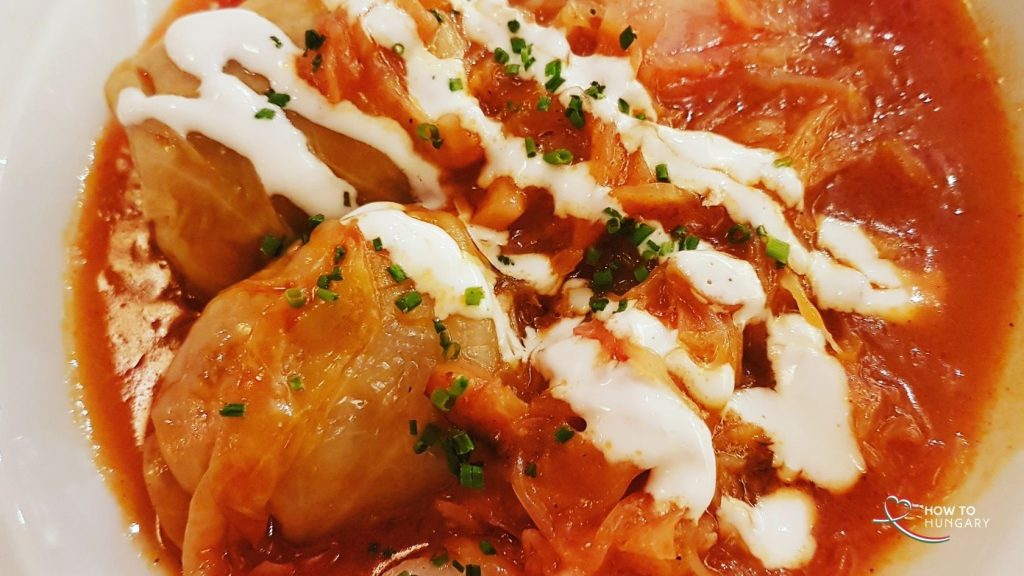
Töltött káposzta: Hungarian cabbage rolls so stuffed with porky goodness and paprika magic, they promise Christmas wealth – because who wouldn’t roll in riches after devouring these sour-sweet treasures?
Useful Tips for Newcomers (and Forgetful Expats)
- Shops and transit close early on 24 December. By early afternoon, most of the country winds down.
- Bakery orders require commitment. If you forget to call ahead, expect limited selection.
- Supermarkets get chaotic. Do your big shop a few days earlier.
- Szaloncukor quality ranges widely. Taste-testing is part of the cultural immersion.
For broader December planning, my guide to Hungarian grocery shopping is helpful for timing and expectations:
https://howtohungary.com/2025/03/17/hungarian-grocery-shopping/
For an external source on seasonal events and food traditions, the Visit Hungary site updates listings throughout December:
https://visithungary.com
Stepping Into the Season
As I finish writing this, it strikes me how much Hungarian Christmas foods set the tone for the weeks ahead. Even after years of living here, I still feel that small shift the moment December arrives – the steady appearance of bejgli in shop windows, the first boxes of szaloncukor migrating onto the tree, and the unmistakable smell of forralt bor drifting through the markets. Although many of these dishes have been part of my life since childhood, they take on a different weight here. The traditions are closer, the ingredients feel more intentional, and the pace of the season builds in a way that’s both familiar and completely its own.
Because we’ve just left the fog-heavy quiet of western Hungary and returned to Budapest, we’re right at that point in the season where everything begins to gather momentum. The cottage is closed for winter, the city is lighting up, and the calendar is starting to fill. Later today, Andrew and I will head out for a cup of forralt bor – perhaps a forralt csoki if I’m feeling optimistic – and take our first proper walk through the markets. It’s the beginning of our December ritual: chimney cake comparisons, bakery loyalty debates, and the ongoing question of how much szaloncukor Andrew will “sample” before Christmas week even arrives.
—
Enjoyed this post? Sign up for my FREE monthly newsletter – the HOW TO HUNGARY Insider.
Living in a new country is never simple, but it doesn’t have to be overwhelming. Each month, I share the latest Hungary updates, expert advice, personal insights from someone who’s actually done it – and absolutely no affiliate links.

Anikó Woods is a Canadian-Hungarian writer, technology specialist, and digital strategist who swapped Toronto traffic for Hungarian bureaucracy. She’s the creator of HOW TO HUNGARY: Budapest & Beyond. Since moving to Hungary in 2017, she’s been deep in the paperwork trenches – fact-checking, interviewing experts, and helping others make sense of the madness. Her writing turns chaos into clarity, with a few laughs (and wine recommendations) along the way.
0 Comments