April in Hungary always feels like a bit of a reset. We’re heading into the long Easter weekend, and I’m writing this from the countryside, watching grey skies that are apparently about to turn into 20 degrees and sunshine by Sunday. Andrew and I already have plans involving a long lunch at one of our favourite wineries, which feels like the right way to ease into spring.
This morning, though, I posted a simple list of healthcare emergency numbers in Hungary (English) and got far more responses than I expected. Messages, shares, a few “I had no idea” replies. It reminded me how many people, including Hungarians, don’t actually have these saved. I mentioned the same numbers last week while speaking at the Embassy of the Philippines, and saw the same reaction in the room.
So this is the version you keep. The numbers, the apps, all in one place, ready when you need them.
Quick answer: If something goes wrong in Hungary and you need English support, call 112 for emergencies. For urgent but non-life-threatening issues, call 1830. For general health questions, call 1812. The Életmentő app can send your location to ambulance services, and Egészségablak app gives access to prescriptions and records.
Which Numbers To Call In Hungary (In English)
If you remember nothing else, remember this: not every situation is a 112 situation.
When people search for healthcare emergency numbers in Hungary in English, they’re usually trying to figure out which number to call, not just what the numbers are. Hungary’s system is fairly straightforward once you know how it’s split, but that distinction matters, especially if you’re trying to explain yourself in English under pressure.
112 – Emergency Services
This is the number for anything urgent and potentially life-threatening. Ambulance, police, fire. It’s the same system used across the EU, and operators can handle calls in English.
Use it for situations like:
- serious injury or sudden illness
- accidents
- anything where immediate response is needed
If you’re unsure, call 112. No one expects you to get it perfect.
1830 – Medical On-Call (Ügyelet)
This is the one many people don’t know.
1830 is for urgent medical issues that can’t wait, but aren’t life-threatening. Think a high fever late at night, a child who suddenly gets worse on a weekend, or something that needs medical advice outside normal hours.
They can advise you over the phone or direct you to the nearest on-duty clinic. English support is available, although it can depend on who answers.
1812 – National Health Line
This is more practical than urgent.
1812 is a 24/7 health information line, useful when you’re trying to figure out where to go, how the system works, or how to book certain referred specialists.
It’s not for emergencies, but it can save you a lot of time if you’re navigating healthcare in Hungary for the first time.
A small reality check. Even when services support English, not everything around them will. Addresses, clinic names, and follow-up instructions often come in Hungarian. It’s manageable, but easier if you expect it.
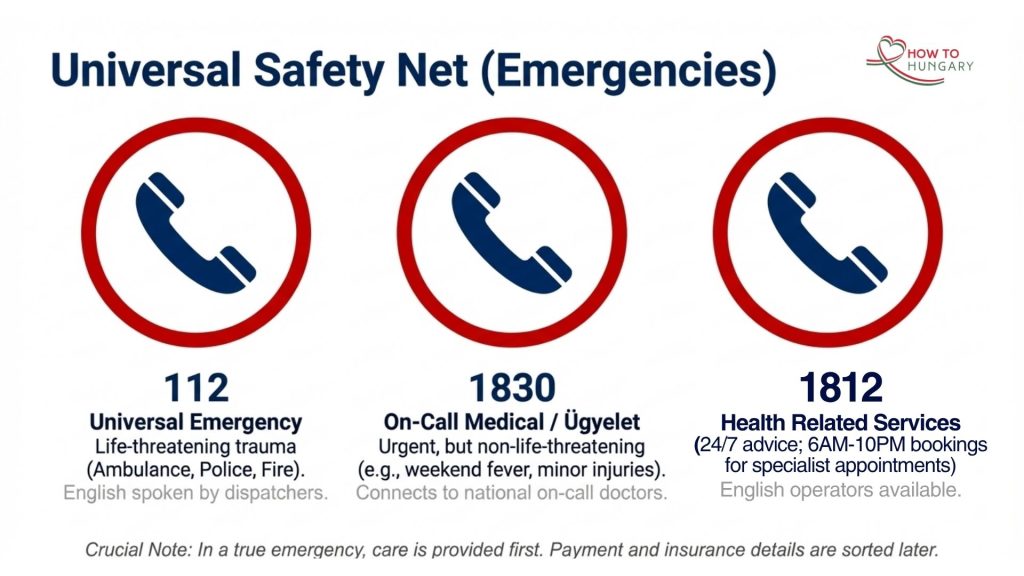
These are the three numbers to save. If you remember one, make it 112.
The Apps That Make This Easier
Hungary has moved quietly towards an app-first system for a lot of its healthcare and emergency services. If you live here, or even spend part of the year here, there are two apps worth setting up before you ever need them.
Életmentő App (Lifesaver)
This is the one I tell everyone to download.
It connects directly to the National Ambulance Service and, with one tap, can contact emergency services and send your exact GPS location. If you can’t explain where you are in Hungarian, or you’re somewhere unfamiliar, it removes that problem entirely.
For us, it’s essential. Our house on a wine hill in the countryside doesn’t have a straightforward address, so GPS location is the only reliable way to be found quickly. That alone makes this worth having set up in advance.
You can also store basic medical information in the app, which can be accessed if you need assistance. In our case, it means it’s immediately clear that Andrew is an English speaker and that key details, like a TAJ number, are already there.
And this isn’t just a countryside issue. If you’re out in the city, late, tired, or somewhere you don’t recognise, the same problem applies. Not everyone can pronounce street names under pressure.
The interface is available in English and takes a few minutes to set up. It’s one of the few apps here I’d consider essential.
Egészségablak App
This is one of the main tools behind how healthcare in Hungary works, even if you don’t immediately connect it to emergency numbers in Hungary in English.
The Egészségablak app gives you access to your prescriptions, medical records, and social security status in one place. After logging in with Ügyfélkapu or DÁP, you can switch the interface to English.
You can use it to:
- view your e-prescriptions (e-Recept)
- access medical reports and vaccination records
- check your coverage status (the “TB lamp”)
It saves time. You’re not chasing paper prescriptions or trying to remember where something was sent.
One limitation to be aware of. The interface can be in English, but most documents inside the app are still in Hungarian. You’ll likely end up using a translation app at some point. That’s normal.
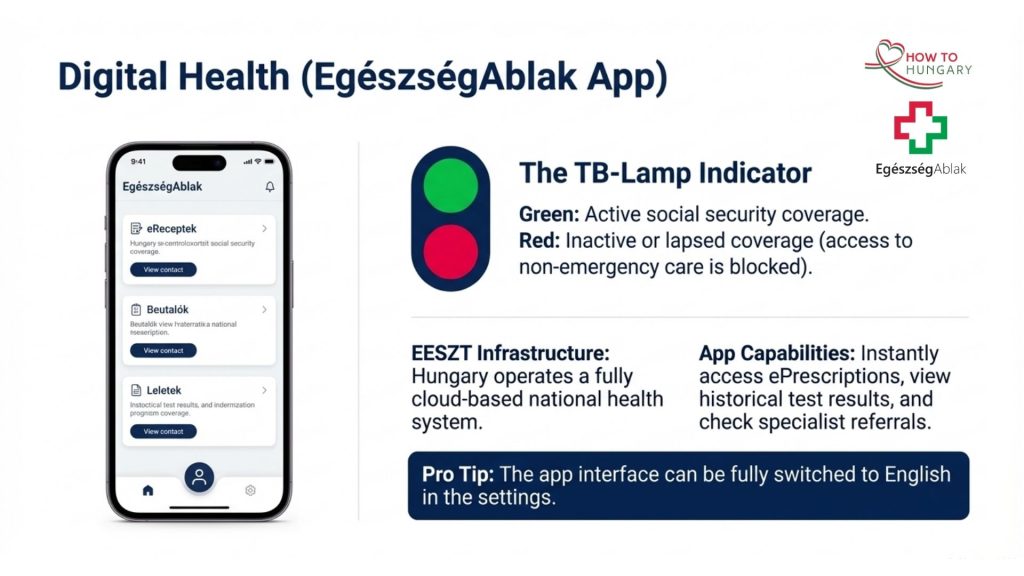
What your healthcare looks like once you’re in the system. Prescriptions, records, and that small but important green light.
Don’t Leave it Too Late
You can have the right emergency numbers in Hungary in English saved and still lose time in the moment. The issue isn’t always the number. It’s everything around it.
Addresses don’t always translate cleanly. Street names can be long, unfamiliar, and difficult to pronounce under pressure. Even reading them out from a screen can go wrong if you’re flustered or tired.
I’ve had moments here where I’ve double-checked an address before heading out, just in case I’d need to explain where I was later. That’s not something I ever thought about before living in Hungary.
And then there’s the follow-up. Instructions, clinic details, paperwork. Even when the initial call is handled in English, what comes next is often in Hungarian.
None of this is unmanageable. It just takes a bit more preparation than most people expect.
Saving the numbers helps. Setting up the apps helps more. Doing both before you need them is what makes the difference.
FAQ
What emergency number should I call in Hungary if I need help in English?
If you need urgent help in Hungary and want English support, call 112. This is the main emergency number for ambulance, police, and fire services, and English-speaking operators are available. For most internationals, this is the number to remember first. If the situation is serious, sudden, or unclear, 112 is the safest option.
What is 1830 in Hungary used for?
1830 is Hungary’s national medical on-call number for urgent health problems that are not immediately life-threatening. It is useful for issues like a high fever at night, a child getting worse on a weekend, or a problem that cannot wait until normal clinic hours. English support is available, although the experience may vary depending on who answers.
What is the Egészségablak app used for in Hungary?
The Egészségablak app gives you access to prescriptions, medical records, vaccination history, and your social security status in one place. After logging in with Ügyfélkapu+ or DÁP, you can switch the interface to English. It is one of the most useful healthcare tools to set up in advance, even though many of the documents inside the app still appear in Hungarian.
Why is the Életmentő app worth downloading in Hungary?
The Életmentő app is worth downloading because it can contact emergency services and send your exact GPS location with one tap. That is especially useful if you are in the countryside, somewhere unfamiliar, or unable to explain your location clearly in Hungarian. You can also add medical details and language information, which makes the app one of the most practical tools linked to emergency numbers in Hungary in English.
Will healthcare instructions and medical records in Hungary be in English?
Not always. Even when emergency numbers in Hungary in English are available, the follow-up information often is not. Medical reports, clinic instructions, and official documents are still usually issued in Hungarian. In practice, that means many internationals end up using a translation app as part of everyday healthcare admin, even when the first phone call is handled in English.
Save This Now, Not When You Need It
If you’re setting this up, the next step is knowing where to go once you’ve made that call. I’ve written a full guide on How to find your GP in Hungary, which is worth bookmarking as well, especially if you’re still figuring out how the system fits together.
If you want the full picture, from public coverage to private options and how it all works, I cover it in detail in HOW TO HUNGARY: Budapest & Beyond. It’s the version with everything in one place, so you’re not piecing it together from ten different sources.
And with the long weekend coming up, this is a good moment to get it all set up. Save the numbers, download the apps, and then go and enjoy the sunshine when it finally shows up. I’ll be doing the same, likely with a glass of wine somewhere in the Balaton Highlands.

Anikó Woods is a Canadian-Hungarian writer, technology specialist, and digital strategist who swapped Toronto traffic for Hungarian bureaucracy. She’s the creator of HOW TO HUNGARY: Budapest & Beyond. Since moving to Hungary in 2017, she’s been deep in the paperwork trenches – fact-checking, interviewing experts, and helping others make sense of the madness. Her writing turns chaos into clarity, with a few laughs (and wine recommendations) along the way.
0 Comments