
As I write this, Hungary is wrapped in fog. Thick, lingering fog that refuses to lift. It has been an unusually heavy winter here. The kind that makes you understand why some cultures don’t simply wait for spring to arrive.
At the same time, the eastern seaboard of North America is buried. Toronto alone is dealing with more than 60 centimetres of snow. Growing up in Canada, winter meant silence, shovels, and endurance. You waited it out. Hungary takes a different approach.
Busójárás 2026 in Mohács is a six-day winter festival where noise, fire, and disguise are used to mark the end of the cold season. From 12 to 17 February, the southern town of Mohács fills with people wearing hand-carved wooden masks and heavy sheepskins. Cowbells ring constantly. Fires burn along the Danube. Winter is not acknowledged politely. It is driven out.
For anyone from the U.S., the UK, or Canada, this can feel almost surreal. There is no quiet transition into spring here. There is a collective decision that winter has had long enough.
Why This Festival Exists
Busójárás is not nostalgia dressed up for visitors. It is a working tradition rooted in season and survival.
The festival is closely tied to the local Šokci community, who believed winter could be driven away through noise, disguise, and collective presence. This was never symbolic in the abstract. The cold affected crops, travel, and daily life. Making winter leave mattered.
That mindset still shapes Busójárás 2026 in Mohács today. It takes place just before Lent, the last major communal release before restraint sets in. There is nothing subtle about it. Bells, fire, smoke, and movement are the point.
UNESCO recognised Busójárás as Intangible Cultural Heritage in 2016 for a simple reason. It is still alive, practised by families who pass masks and roles down through generations, not preserved behind ropes.
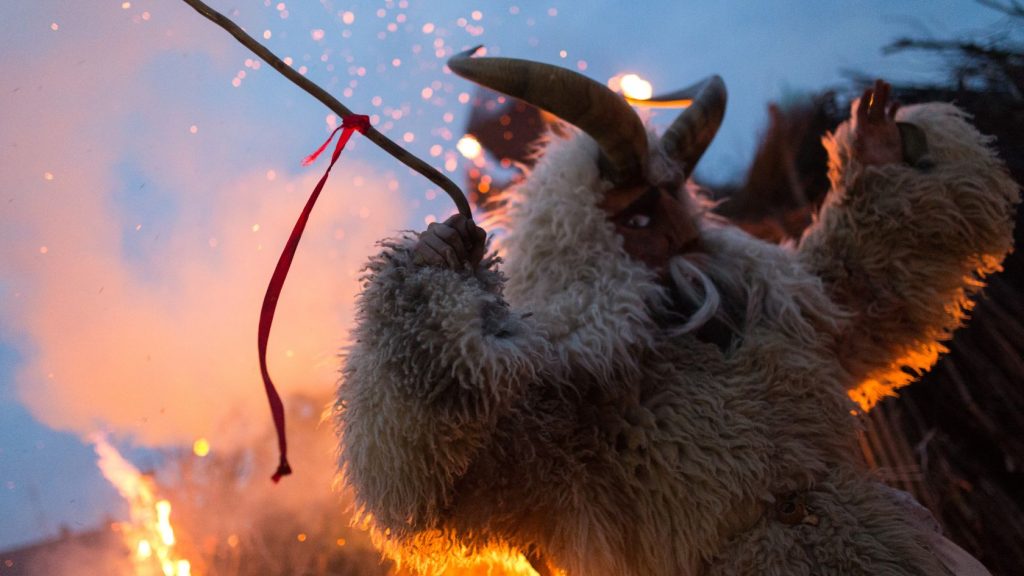
When winter is chased out with fire, bells, and no patience left.
Busójárás 2026 Dates
Busójárás runs for six days, with energy building toward a deliberately dramatic end.
The opening procession takes place on Thursday, 12 February, when the first large groups of busós move through town in mid-afternoon. From Friday through Monday, processions repeat alongside craft workshops, markets, and evening fires. Each day layers on intensity rather than repeating the same experience.
The final night, Tuesday, 17 February, centres on the Danube. A straw figure representing winter is placed on a boat, pushed onto the river, and set alight. Fireworks follow. The message is not ambiguous.
Getting There and Staying Over
Mohács is straightforward to reach, but February logistics reward planning.
Trains from Budapest take roughly two hours and fill quickly once festival dates approach. Booking ahead matters more than usual. From the station, the walk into town is manageable even in winter conditions.
Accommodation books early. Guesthouses near the river typically range between 15,000 and 25,000 HUF per night. Family-run places are often the most flexible and the most generous with practical advice. A day trip is possible, but staying overnight gives you access to the evening fires that define the atmosphere.
What You’re Actually Seeing
The visual impact of Busójárás 2026 in Mohács is intentional, not theatrical.
Masks are carved from willow wood and designed to unsettle. Horns, teeth, exaggerated expressions. Sheepskins add weight and bulk, changing how bodies move. Heavy bells worn at the waist ensure constant noise.
Traditionally, men take on the role of busós, while women wear lighter masks and traditional skirts. Many masks are family pieces, reused year after year. This is not costume culture. It is continuity.
The rituals work because they are physical. Fire heats the air. Bells overwhelm the senses. Movement fills the streets. Winter is not politely acknowledged. It is actively removed.
What It Feels Like to Be There
Footage gives you the visuals. It does not give you the experience.
Crowds press close, especially in the evenings. Smoke hangs in the air and stings your eyes. Heat from open fires cuts sharply through the cold. Bells never fully stop. At times, it feels less like watching an event and more like standing inside it.
That slight disorientation is part of the design. This is not meant to be consumed passively.
What to Wear
February in southern Hungary usually sits between zero and five degrees, but standing still changes everything.
Layers matter more than style. Thermal base layers, wool, and a weatherproof outer layer work best. Footwear needs grip. Streets can be wet, muddy, or icy. Cash is still useful for market stalls, even though accommodation generally accepts cards.
Daytime events are calmer and suit families well. Evenings are louder, more crowded, and more intense.
Planning Around It
Please arrive by public transport if possible. The official site for visitor information can be found here.
If you are already mapping out winter travel, this pairs well with broader calendar planning. My guide to Hungarian public holidays in 2026 helps avoid transport surprises and closure days if you are extending your trip.
For official background and cultural context, UNESCO’s overview of Busójárás is still a reliable reference.
FAQ: Busójárás 2026
What is Busójárás in Mohács?
Busójárás is a traditional Hungarian winter festival held in Mohács, where people wearing carved wooden masks and sheepskins use noise, fire, and ritual to mark the end of winter before Lent.
When is Busójárás 2026?
Busójárás 2026 takes place from 12 to 17 February, with the main closing rituals held on Shrove Tuesday.
Is Busójárás a religious event?
No. Although it happens just before Lent, Busójárás is a folk tradition based on seasonal customs rather than a religious celebration.
Do you need tickets to attend Busójárás?
No. The main parades, street events, and fire rituals during Busójárás are free and open to the public. More info here.
Is Busójárás suitable for families?
Yes. Daytime events are generally suitable for families, while evening rituals are louder, more crowded, and may feel intense for young children.
Why This Winter Deserves It
This winter has tested everyone in our household. The cold has felt endless. The days have been short and dark. My mum is over it. Andrew is over it. My sister and her husband are over it. And the dogs have made it very clear that they are absolutely, completely done with cold paws and muddy walks.
So while I won’t be in Mohács this February, I will be cheering from afar. Because there is something deeply satisfying about a community deciding, together, that winter has had enough. No waiting. No optimism. Just action.
And honestly, I cannot wait for spring.
It also feels fitting that my updated HOW TO HUNGARY: Budapest & Beyond – 2026 edition is landing soon. Like spring, it’s almost here. In the next week or so, it’ll be out and available, refreshed for the year ahead. New season, new edition. And hopefully, a little more light on all fronts.

Anikó Woods is a Canadian-Hungarian writer, technology specialist, and digital strategist who swapped Toronto traffic for Hungarian bureaucracy. She’s the creator of HOW TO HUNGARY: Budapest & Beyond. Since moving to Hungary in 2017, she’s been deep in the paperwork trenches – fact-checking, interviewing experts, and helping others make sense of the madness. Her writing turns chaos into clarity, with a few laughs (and wine recommendations) along the way.
0 Comments