
Last Wednesday evening at KLUSTER, every chair was taken. By 17:30 the room was full. Coats piled on chairs. Latecomers hovering near the back wall. That particular February light outside that makes Budapest feel grey and theatrical at the same time.
The event was called Finding Your Hungarian Voice. I was hosting and moderating. The room was a mix of long-term internationals, recent arrivals, heritage returnees, and a few brave beginners who admitted they were still stuck at “jó napot”.
Before we even began, someone near the front said what most people were thinking:
“So… is Hungarian impossible?”
The Reputation
Hungarian has a reputation. Double consonants. Fourteen vowels. Endless cases. Words that look like someone leaned on the keyboard. Even confident professionals find themselves reduced to pointing at bakery counters.
In the room were people who had already crossed that line.
Mark Downey, Irish entrepreneur, first learned Hungarian not in Budapest cafés but in the countryside. Frederik Cornelius, 24, Danish, musician, settled near Pécs and decided immersion was easier than retreat. Andy Clark, football reporter and translator, working daily in Hungarian. And Ákos from Magyarize, who sees learners stall and succeed in equal measure.
Nobody described Hungarian as easy. Nobody described it as impossible either.
The Fear
What came up quickly wasn’t grammar. It was fear.
People apologise before they speak. They lower their voice halfway through a sentence. They preface every attempt with “Sorry, my Hungarian is terrible.” That apology becomes the barrier.
Ákos put it simply: Hungarian is consistent. It is logical once you see the patterns. The real problem is hesitation.
Several audience members nodded. One woman admitted she can read quite comfortably but freezes in conversation. A man in the back said he understands far more than he allows himself to use.
The fear of sounding foolish is louder than the grammar.
The Sound
One of the most useful phrases of the evening was this: Hungarian is a “piano language.” Once you learn the keys, they always make the same sound. Unlike English, Hungarian spelling is stable. The letter makes the sound. Every time.
The trick is not cases. It is your mouth.
Long and short vowels matter. Stress is always on the first syllable. Certain consonant pairs feel unnatural at first. You have to physically adjust how you speak. Mark described it as rearranging your mouth before rearranging your brain. That landed.
The “Click”
Progress in Hungarian does not glide. It stalls. Then it jumps.
Mark told the story of arriving years ago in Kőbánya, feeling visibly out of place. White polo shirt. Chinos. Industrial surroundings. Smoke and overalls. He described it as stepping into a black-and-white photograph. The breakthrough did not happen in a classroom. It happened in a crowded rural pub. He realised he could follow enough of a conversation to interrupt, comment, and order his drink without panic.
That was the click.
Frederik spoke about living next to an elderly neighbour who spoke no English. Daily fence conversations forced him forward. No switching languages. No retreat. Confidence arrived not from perfection, but from necessity.
Several people in the audience shared similar moments. Utility installers. Land registry offices. Unexpected phone calls. Situations where English simply wasn’t an option. Pressure builds fluency.
The Structure
Yes, Hungarian is agglutinative. Words stack. Meaning often arrives at the end.
Andy joked that after years of Hungarian, his English sometimes sounds slightly rearranged. You hold the intention until the last word drops into place. There was laughter when Mark recalled thinking Budapest was obsessed with “Sajt” before realising everyone was saying Sajnos. Misunderstandings are part of the process.
Hungarian builds meaning like engineering. Attach the right suffix, and the structure stands. Misplace it, and it wobbles. But it is not chaotic. It is systematic.
The Shift
At some point in the evening, the tone changed. The question “Is Hungarian impossible?” softened into something else.
“How long did it take before you felt comfortable?”
“What was your worst mistake?”
“Do Hungarians really mind accents?”
The room was no longer asking whether the language could be learned. It was asking how to stay in it long enough for it to work. Hungarians are protective of their language. They are also observant. Effort is noticed. Even imperfect effort.
Frederik said something that stayed with me: Hungarian is not just a tool. It is an identity marker. When you use it, even imperfectly, you signal that you want to participate. Not visit. Participate.
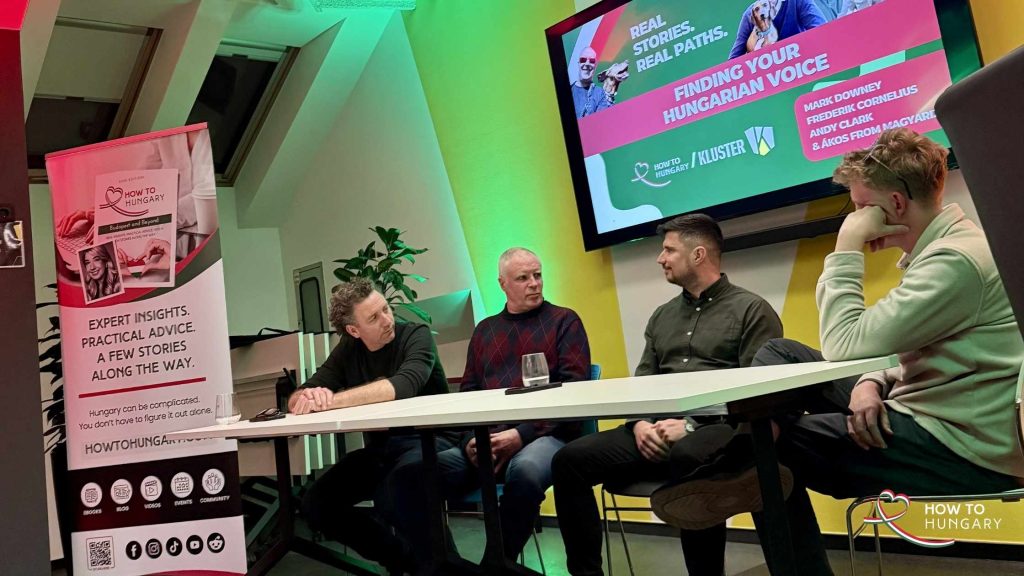
From countryside immersion to professional translation, the panel reflected on the plateaus, the breakthroughs and the moment it finally clicks.
Helpful Links
If you are deciding how much Hungarian you actually need, this piece may help:
Do You Need to Learn Hungarian in 2025?
https://howtohungary.com/2025/03/26/learn-hungarian-2025/
For background on International Mother Language Day:
UNESCO https://www.unesco.org
FAQ: Is Hungarian Impossible?
Is Hungarian really impossible to learn?
No. Hungarian is demanding and structurally different from English, but it is not impossible. It follows consistent pronunciation rules and logical patterns. For most learners, fear and hesitation are bigger barriers than grammar.
Why does Hungarian feel so difficult at the beginning?
The sound system, long and short vowels, and unfamiliar sentence structure can feel disorienting at first. Hungarian builds meaning by adding suffixes to root words, and meaning often arrives at the end of the sentence. Once learners focus on pronunciation and rhythm, comprehension improves steadily.
Should I focus on grammar or pronunciation first?
Pronunciation first. Hungarian is phonetically consistent, which means once you learn the alphabet and sound system, you can pronounce most words correctly. Clear pronunciation allows communication even when grammar is imperfect.
How do learners break through plateaus?
Progress often happens in jumps after periods of slow improvement. Many learners experience breakthroughs during real-life conversations where switching to English is not an option. Speaking out loud, repetition, and accepting mistakes build confidence faster than silent study.
“You don’t need to be perfect to belong here in Hungary. You do not need to speak beautifully to participate in community. You just need to begin or continue.” – Anikó Woods
Immersion Is a Choice
Mastering Hungarian is, ultimately, a choice of immersion. It requires hours, repetition, and a willingness to sound slightly foolish in public. In exchange, you gain something practical and quiet: confidence. Whether you are standing in a bureaucratic office in Kőbánya or chatting over a fence in Szeged, the language becomes less of a wall and more of a working tool.
The real question is not whether Hungarian is hard. It is whether you are prepared for your own “ah ha” moment. The evening when you suddenly realise you are following the conversation instead of translating it. That shift does not arrive through theory. It arrives because you kept speaking.
And that, more than talent or age, is what changes everything.
Until the Next Conversation
First, thank you.
To Mark, Frederik, Andy and Ákos, thank you for speaking honestly. You didn’t tidy up the struggle or romanticise the breakthroughs. Instead, you described the stalls, the awkwardness and the small decisions that eventually made Hungarian usable. That candour is far more helpful than any grammar chart.
Equally, thank you to everyone who filled the room at KLUSTER. The audience stories mattered just as much as the panel. Because of your questions and shared experiences, the evening shifted from theory to something much more grounded. It became a collective reflection on what it actually takes to stay with a language long enough for it to respond.
Encouragingly, many of you asked whether we would do this again. So, we will. If the interest in the room was any indication, this conversation is far from finished. Therefore, we are already looking at hosting another Hungarian language evening in the autumn.
In the meantime, if you would like to hear about future events, panel discussions and community gatherings at KLUSTER, the simplest way is to join my newsletter. That is where I share dates first. It is also where these conversations continue, even between events.
After all, Hungarian does not unfold in one evening. However, it does move forward each time we show up.

Anikó Woods is a Canadian-Hungarian writer, technology specialist, and digital strategist who swapped Toronto traffic for Hungarian bureaucracy. She’s the creator of HOW TO HUNGARY: Budapest & Beyond. Since moving to Hungary in 2017, she’s been deep in the paperwork trenches – fact-checking, interviewing experts, and helping others make sense of the madness. Her writing turns chaos into clarity, with a few laughs (and wine recommendations) along the way.
Fabulous! My great grandmother immigrated from Budapest to America in 1922, so I qualify for simplified naturalization. It’s easy to say, let me learn just enough to get by, but I want to honor her legacy, so I want to learn the language. This article made my hope of achievement more attainable. Thank you.
Honouring your great grandmother in that way feels very different from “just getting by.” It changes the tone of the whole journey. And simplified naturalisation is one thing. Actually hearing and speaking the language she left behind is something else entirely.
It won’t always feel smooth. However, that connection you’re building is real, even on the awkward days.
If you do move forward with it, I hope you have your own “click” moment sooner than you expect. 🙏
I’m lucky because I always spoke Hungarian at home with my parents. Sadly I have not been practising my Hungarian for many years now as I have no one to speak with. But I’m sure I would pick it up very quickly again, especially if I was in Hungary…
Kedves Aniko,
I am so happy that you are a Canadian Hungarian like me. My Father is Hungarian, but due to his personal political feelings at the time, he only spoke English at home while my Italian Mother made sure we had Hungarian Meals served from time to time and we went and participated in Hungarian Church Masses and Events whenever they presented themselves. I did take Hungarian language classes and I do have a strong base in pronunciation and the basic functions of grammar. I stopped pursing it, but try to communicate with my Hungarian born cousins here in my community. Now that I am retired, I would like to spend more time in perfecting my Hungarian so that I can have a normal conversation with others.
Kedves Aniko,
I am so happy that you are a Canadian Hungarian like me. My Father is Hungarian, but due to his personal political feelings at the time, he only spoke English at home while my Italian Mother made sure we had Hungarian Meals served from time to time and we went and participated in Hungarian Church Masses and Events whenever they presented themselves. I did take Hungarian language classes and I do have a strong base in pronunciation and the basic functions of grammar. I stopped pursing it, but try to communicate with my Hungarian born cousins here in my community. Now that I am retired, I would like to spend more time in perfecting my Hungarian so that I can have a normal conversation with others.
What a lovely message. Your story sounds very familiar. The good news is that if you already have the pronunciation and grammar basics, you’re much further ahead than most people. Hungarian has a way of coming back once you start using it again. Conversations with family are honestly one of the best ways to rebuild it.
And retirement is the perfect time to dive back in. I’m still learning myself after years of living here. You’re definitely not alone in that journey. 😊