
No Phones, All Day: Hungary’s New School Rule
From today, 1 September 2026, pupils in Hungary’s általános iskola (the eight-year general school, grades 1 to 8, ages 6 to 14) must keep their phones off for the whole school day, The rule covers phones and other communication or recording devices, with exceptions a teacher can grant for schoolwork, plus health, disability and emergency needs. The new school year runs to 18 June 2027, and this is the change international parents will feel first.
I have lived in Hungary since 2017, I run How to Hungary, and I have spent the past week answering the same question from parents in the community: is it the whole day now, or just class time? Short answer, the whole day. Here is what that means and how Hungary lines up against Canada, the US and the UK, because three of those systems moved on phones this year too.
Phones Banned in Hungarian Schools: The Rule
The Oktatási Minisztérium (Ministry of Education) set the rule for általános iskola, the primary and lower-secondary years. Pupils switch phones off for the full school day. That includes breaks, the corridor, the yard and lunch, not only the forty-five minutes of a lesson.
Teachers keep some discretion. A teacher can let pupils use a device for a specific task, say a class research activity. Schools also allow phones where a child needs one for a medical reason, a disability or a genuine emergency. A continuous glucose monitor that pairs with a phone is the textbook example, and schools are expected to accommodate it.
One honest caveat from my own week of asking around: schools are still writing the fine print. How a device gets stored, whether it goes in a bag, a locker or a pouch, and what happens on a school trip, all of that lands at the school level. If you have a child starting this week, ask your school directly rather than assuming. I did, and got three slightly different answers from three families.
The Short Version for Busy Parents
Phones stay off, all day, in primary schools. Teachers can permit device use for schoolwork. Medical, disability and emergency needs override the ban. The measure applies from the first day of the 2026/2027 year, which is today.
How Hungary Compares: Canada, the US and the UK
Hungary is not an outlier. If anything, it joined a wave. The interesting part is who decides the rule, and here the four countries split cleanly.
| Country | Who sets the rule | Scope in 2026 | Key exceptions |
|---|---|---|---|
| Hungary | National (Ministry of Education) | Whole school day, primary schools | Teacher-approved schoolwork, medical, disability, emergency |
| England (UK) | National, statutory guidance | “Phone-free by default”, state schools, from 1 Sept 2026 | Medical need (e.g. glucose monitors); post-16 excluded |
| Canada | Province by province | Varies: Quebec full grounds; Ontario tiered by grade | Medical and learning-needs exceptions, set provincially |
| US | State by state | 26 states “bell to bell”; 35 states plus DC have a policy | Vary by state law |
As of 1 September 2026. Provincial and state rules change often, so check the local authority before quoting a specific policy.
The UK: Statutory From the Same Day
England makes the neatest comparison, because it moved on the same date. The Department for Education first issued non-statutory guidance in February 2024. A revised version became statutory under the Children’s Wellbeing and Schools Act 2026 on 29 June 2026, and schools are expected to follow it from 1 September 2026. The standard is “mobile phone-free by default”. Ofsted, the schools inspectorate, now checks how well a school actually applies its policy. The rule covers state schools in England and stops short of post-16 colleges. Scotland runs its own guidance, published in August 2024.
Canada: A Provincial Patchwork
Canada has no national rule, and as a Canadian I find the contrast telling. Each province writes its own. Quebec went furthest: from September 2025, pupils cannot use a phone anywhere on school grounds, indoors or out. Ontario has restricted phones since 2019 and tightened the rules in 2024, using a tiered approach by grade. British Columbia, Alberta, Manitoba, Saskatchewan and Nova Scotia all have rules or are building them. Same country, several answers.
The US: State by State
The US is the widest patchwork of all. By December 2025, 35 states and Washington, DC had passed a law or policy on phones in K-12 schools. Of those, 26 states require a full “bell to bell” ban that runs the entire school day, New York among them. Another handful restrict phones only during instructional time. There is no federal rule, so a family moving between states can meet very different policies.
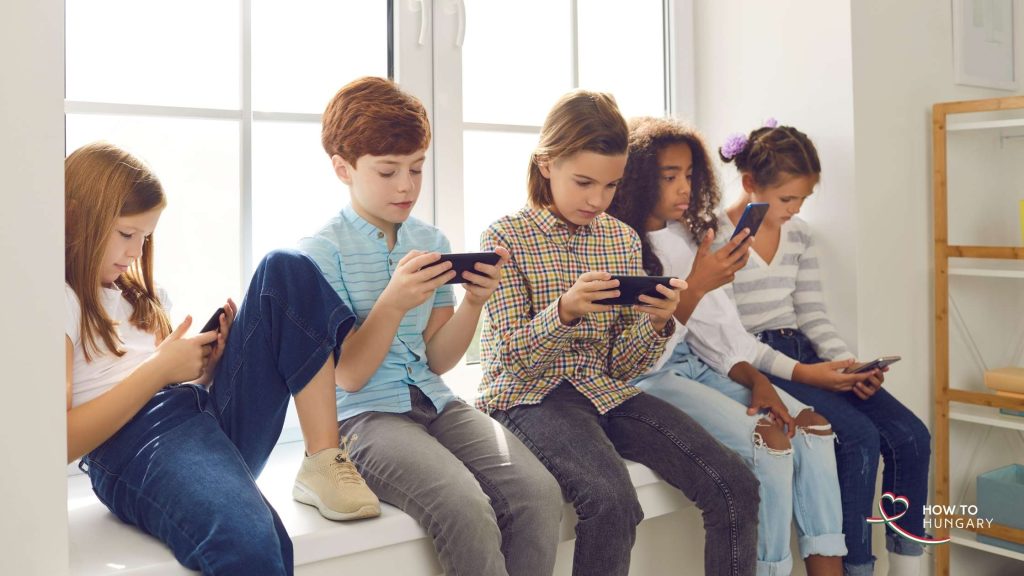
Five kids, five screens, one windowsill. From September, this exact scene stops at the school gate.
What This Means for International Families
If you moved here from England, the logic will feel familiar, though the paperwork will not. If you moved from Canada or the US, the surprise is that Hungary decided this once, nationally, rather than leaving it to your district or province. That has one practical upside: you do not need to research your specific school’s stance on whether phones are allowed at all. The default is off.
The variable that remains is enforcement. A national rule sets the floor. Your child’s school sets the daily reality, from where the phone lives during the day to how a teacher handles a first slip. So the useful move this week is not to read another summary. It is to email the class teacher and ask the three questions below.
Questions Parents Are Asking
Does the ban cover the whole day or just lessons? The whole school day in általános iskola (the eight-year grade school), as of 1 September 2026. That includes breaks, the yard and lunch, not only lesson time. Teachers can still permit a device for a specific classroom task. If your school has framed it as “lessons only”, that is out of step with the national rule, so it is worth a polite check with the school office.
What if my child needs a phone for a medical reason? Medical needs are a recognised exception. A common case is a continuous glucose monitor that pairs with a phone for a child with diabetes. Schools are expected to accommodate a genuine medical need, along with disability and emergency situations. Put the request in writing to the school early, ideally before or during the first week, so the arrangement is on record.
How will schools actually store the phones? The national rule sets the requirement, but storage sits with each school. Some ask for phones switched off in bags, others use lockers or pouches. There is no single national method as of September 2026. Ask your school directly, because practice varies and school-trip rules can differ again.
Does this apply to secondary and post-16 students too? The rule targets általános iskola, the primary and lower-secondary years. Older students in secondary and vocational settings may meet different school-level policies. If you have a teenager, confirm the specific policy with their school rather than assuming the primary rule carries across.
Is Hungary stricter than where we moved from? It depends on your home system. England’s “phone-free by default” standard, live from the same day, is broadly comparable. Canada and the US vary by province or state, so some families will find Hungary stricter and others will find it familiar. The clean difference is that Hungary set one national rule instead of a regional patchwork.
Related Reads
- Compulsory Education in Hungary: 2025 Parent Guide
- Emergency Phone Alerts in Hungary
- Feeling Safer on Budapest Transport (BudapestGO) – getting to school
- Official source: the 2026/2027 school-year order, published via kormany.hu.
Another year starts
Andrew and I are watching this school year from the winehouse in the Balaton Highlands, with no school run in sight. We went to Tesco today and felt the change before we clocked it. Quiet aisles, no clatter of kids, everyone back in class. I do not have school age children, so this one I follow from the sidelines, but half the community I write for is deep in it this week.
If you are moving to Hungary or still finding your feet, my Thinking About Hungary newsletter sends the practical updates, dated and checked, to your inbox. For the full picture, the How to Hungary ebook covers residency, tax, healthcare and the school system in one place.

Anikó Woods is a Canadian-Hungarian writer, technology specialist, and digital strategist who swapped Toronto traffic for Hungarian bureaucracy. She’s the creator of HOW TO HUNGARY: Budapest & Beyond. Since moving to Hungary in 2017, she’s been deep in the paperwork trenches – fact-checking, interviewing experts, and helping others make sense of the madness. Her writing turns chaos into clarity, with a few laughs (and wine recommendations) along the way.
0 Comments