
Checked 24 November 2026. Parliament has passed the new KATA law, but it is not yet published in the Magyar Közlöny, the official gazette. Check the published text before you act on any detail.
Andrew and I registered for KATA in 2018, a year after we moved here. For two years it was the one part of Hungarian life I never worried about: one fixed payment a month, one return a year. When we opened our Kft. in 2020, we still had to think about who our clients were, and whether any of them had ever employed us. So when tax comes up at my events, the question is always the same: “Fine, but what if my clients are companies?”
On 24 November 2026, parliament answered it. KATA is back from 1 January 2027, and you can invoice companies again. But the monthly fee has doubled, no more than half your revenue can come from one company, and nothing can come from a former employer. I asked Laci Dudás of Cortaxo to walk through the law parliament actually passed.
Written by László (Laci) Dudás, founder of Cortaxo and a HOW TO HUNGARY Trusted Expert. Introduced and edited by Anikó Woods, who has lived in Hungary since 2017, ran her own business on KATA from 2018 to 2020 and has covered the KATA 2027 changes on HOW TO HUNGARY since they were first proposed in October 2026.
KATA 2027 at a Glance
- Who can use it. Sole traders (egyéni vállalkozó) only. Not companies.
- What you pay in 2027. HUF 100,000 a month (about €260) if this is your main activity. HUF 50,000 (about €130) if you also have a job of at least 36 hours a week, a pension, or are a full-time student or if you are insured in another country for the whole month (for example on an A1 certificate). The lower rate comes with no Hungarian social insurance: see Side Businesses below.
- From 2028. Linked to the minimum wage: about HUF 109,000 (main) and HUF 52,000 (side) a month.
- Revenue threshold. HUF 22 million a year (about €57,300). Above it, the excess is taxed at 40%.
- Company clients. Allowed again, with two conditions on who pays you.
- Benefit base. HUF 317,000 a month in 2027 for a main activity. Your sick pay, maternity benefit and pension are calculated on this.
- When. From 1 January 2027. The law opens registration on 1 December 2026, but NAV can’t publish the form until the law is in the Magyar Közlöny, so it may not be ready that morning. To be on the new KATA from 1 January, register by 31 December. A December registration takes effect on the first day of the following month.
The monthly fee is double the old HUF 50,000, in exchange for company clients. The 2028 figures come from a fixed formula: 31.5% (full-time) or 15% (otherwise) of the 2027 minimum wage, agreed on 19 November at HUF 347,000. You can earn more than 22 million and stay in KATA. Only the part above it is taxed at 40%.
Three words you will see below: a kisadózó is someone who pays KATA. Átalányadózás is the flat-rate income tax most freelancers use today, where a fixed share of your revenue is treated as costs. NAV is the Hungarian tax authority.
Why Hungary Fell for a Tax
Until September 2022, a kisadózó paid HUF 50,000 a month, and that one payment took care of income tax, pension and health contributions, however the month went. About 444,000 people were on it, on figures from GKI Economic Research.
In July 2022 the government gave six weeks’ notice that KATA taxpayers could no longer invoice companies. GKI found that 92% of them had company clients. Within months only 145,000 were left on KATA. Roughly 35,000 businesses shut down and 264,000 moved to other regimes, mostly átalányadózás. GKI expects the new law to reach 300,000 to 350,000 businesses.
People loved it for two reasons, and neither was the tax rate. You knew in January what the year would cost, whether you invoiced two million forints in a month or nothing. And the admin was one payment by the 12th of each month and one return a year, with no monthly tracking against the minimum wage.
The New Rules
1. The One-Client Rule
Keep an eye on your biggest client. The moment one company (together with its related companies) pays you half or more of a year’s revenue, your KATA status stops on 31 December of that year. You then wait twelve months before you can choose KATA again.
In practice: five company clients at 20% each are fine. One client paying you 60% during 2027 means you leave KATA on 31 December 2027 and start the new year on a different regime. Nothing is recalculated for the months you already paid.
Two details matter. A client abroad counts exactly like a Hungarian one. And the test looks at money in your account by 31 December, so an invoice that hasn’t been paid yet doesn’t count towards the half. Anyone with one anchor client should do this sum before looking at any tax comparison.
2. The 15% Top-Up
Income from private individuals carries no extra tax. Income from companies and other organisations does: 15%, but your monthly fees count towards it, so you only pay the difference.
A full-timer pays HUF 1.2 million in fees over a year (about €3,125). That already covers 15% of the first HUF 8 million of company income, so below 8 million there is nothing extra to pay. For a side activity, the fees cover company income up to HUF 4 million. Past those points, your fees plus the top-up add up to 15% of everything companies paid you, rising gradually rather than jumping.
Above the 22 million threshold, private revenue is counted first. Any company money beyond 22 million pays the 40% only, so no forint is taxed at both 15% and 40%.
3. The Former-Employer Rule
This one has the toughest consequence in the new law. Your KATA status ends the day before you receive money from your current employer, or from any employer you left in the past 24 months, including its parent, subsidiary or successor company. A single payment does it, foreign employers count, and you are then barred from KATA for twelve months.
Two of the most common ways to start freelancing fall straight into it: turning your old job into a contract with the same company, or moving to Hungary and carrying on for your employer back home. Both rule out KATA for two years. Routing the work through an agency doesn’t help either. The law looks at who you actually do the work for, and the explanatory memorandum uses staffing agencies as its example.
Anikó’s note: keeping your employer from back home as your first client is the most natural way to start here. Under this rule, it keeps you off KATA for two years. Andrew and I had to think this through when we set up, too.
4. Rent and Tax Debt
- Rental income. Any rent received during the year bars you from choosing KATA, and rent that arrives once you’re in ends your status. Owning a flat is fine. It’s the rent that counts.
- Tax debt. If you owe NAV more than HUF 100,000 on 31 December, you lose KATA. Clear the debt before the decision becomes final and it is cancelled.
- Twelve months out. Whatever the reason your status ends, you can’t return until twelve months after the end of that year.
On the plus side, a full month spent on sick pay, maternity or childcare benefit, nursing allowance, or with your business suspended costs you nothing.
5. VAT Is Separate
KATA covers income tax and social contributions only. VAT follows its own rules: whether you charge it depends on the VAT exemption threshold (alanyi adómentesség). Clients in other EU countries mean you need an EU VAT number and EU sales reports, VAT-exempt or not.
KATA vs Átalányadózás
On átalányadózás, you don’t collect receipts. The law simply treats a set share of your revenue as costs, and taxes the rest. That share is your cost ratio: 45% for most activities (consulting, IT, design, translation, teaching), 80% for a list including building trades, vehicle repair and hairdressing, and 90% for retail.
The 50% cost ratio is off. You may have read that the 45% would rise to 50% in 2027. That was the law, and NAV said so in January. But the 2027 tax package, passed on the same day as the new KATA, keeps it at 45%. Every figure below uses 45%.
It Depends Who Pays You
On átalányadózás, the client mix makes no difference. On KATA it decides the bill, because only company money carries the 15%. Take one business, HUF 20 million of revenue (about €52,000), 45% cost ratio, main occupation, with only the client mix changing. Total tax and contributions for 2027:
- Átalányadózás, any client mix: HUF 4,146,870 (20.7% of revenue)
- KATA, no company clients: HUF 1,200,000 (6.0%)
- KATA, a quarter from companies: HUF 1,200,000 (6.0%)
- KATA, half from companies: HUF 1,500,000 (7.5%)
- KATA, three quarters from companies: HUF 2,250,000 (11.3%)
- KATA, all from companies: HUF 3,000,000 (15.0%)
KATA comes out ahead in every case, saving between about HUF 1.1 million and 2.9 million. But the same business pays two and a half times more on KATA with all-company clients than with all-private ones.
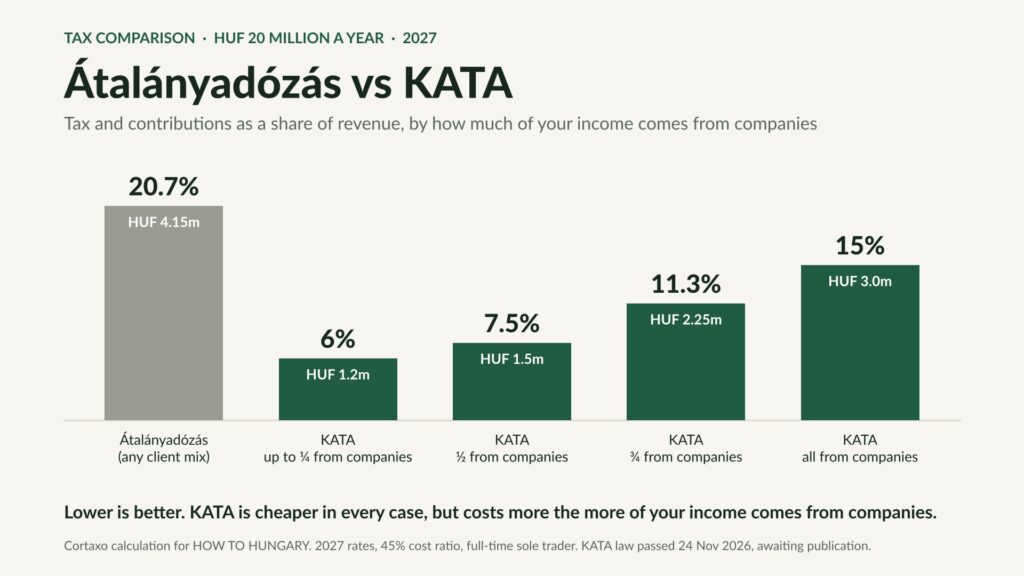
Same business, HUF 20 million a year: KATA wins every time, but the more your clients are companies, the more it costs. Calculation by Cortaxo on 2027 rates.
At Different Revenue Levels
With all revenue from companies, the most expensive case for KATA (45% cost ratio, 2027, all figures in HUF):
- 4 million revenue: átalányadózás 1,329,360 (33.2%), KATA 1,200,000 (30.0%). KATA saves 129,360.
- 8 million: átalányadózás 1,659,360 (20.7%), KATA 1,200,000 (15.0%). KATA saves 459,360.
- 12 million: átalányadózás 2,100,870 (17.5%), KATA 1,800,000 (15.0%). KATA saves 300,870.
- 20 million: átalányadózás 4,146,870 (20.7%), KATA 3,000,000 (15.0%). KATA saves 1,146,870.
- 24 million (above the threshold): átalányadózás 5,169,870 (21.5%), KATA 4,100,000 (17.1%). KATA saves 1,069,870.
- 28 million: átalányadózás 6,192,870 (22.1%), KATA 5,700,000 (20.4%). KATA saves 492,870.
- 32 million: átalányadózás 7,215,870 (22.5%), KATA 7,300,000 (22.8%). Átalányadózás saves 84,130.
- 36 million: átalányadózás 8,238,870 (22.9%), KATA 8,900,000 (24.7%). Átalányadózás saves 661,130.
Cortaxo’s calculation on 2027 figures: minimum wage HUF 347,000, exempt band HUF 2,082,000, full-time sole trader, no allowances, revenue spread evenly. To be checked against the published law.
At 4 million the gap is small, because both systems sit near their minimum. The 2027 átalányadózás contribution floor alone is HUF 109,305 a month (about €285). At 24 million, the whole KATA bill is still only 17.1%, and the two regimes don’t cross until about 31.4 million. Átalányadózás is at its cheapest around 11 to 12 million of revenue, at about 17%.
To run your own numbers, use Cortaxo’s KATA calculator.
With an 80% or 90% cost ratio, átalányadózás comes out cheaper. At 20 million of revenue, all from companies, átalányadózás costs HUF 1,599,360 (8.0%) at 80% and HUF 1,311,660 (6.6%) at 90%, against KATA’s HUF 3,000,000 (15.0%). Work it out carefully before switching.
Seasonal income favours KATA, which the figures above don’t show because they assume even revenue. Átalányadózás contributions are calculated cumulatively, so a strong spring and a dead autumn can leave you paying the monthly floor in months your income never caught up with. On KATA, the monthly fee is the monthly fee.
Allowances, Side Income and Mortgages
No Tax Allowances
On KATA, your monthly fee stands in for income tax on the business. With no income tax to reduce, none of Hungary’s personal allowances work against your business income: not the family allowance, the first-married couples’ allowance, the under-25s allowance, the mothers’ allowances, or the allowance for long-term illness or disability.
That can outweigh everything else. A family with two children gets HUF 40,000 a month per child in 2026, or HUF 960,000 a year (about €2,500). On 12 million of revenue, all from companies, KATA would save that family about HUF 300,000. They would be giving up roughly three times what they save. The family allowance is being restructured for 2027, so check the new figures, though the gap is unlikely to close. A salary from a job keeps its allowances either way.
Side Businesses
For a small side business, átalányadózás has the edge. Its exempt band means the first HUF 2,082,000 of income in 2027 (about €5,420) is free of tax and contributions, and side activities have no minimum contribution base. Earn 3 million forints on the side and átalányadózás costs you nothing, while KATA costs HUF 600,000. KATA only pulls ahead at about 6 million of revenue with private clients, or about 9 million with company clients.
Remember too that the HUF 50,000 rate gives you no social insurance of its own: no Hungarian pension service time, sick pay or jobseeker’s benefit from this activity. You’re covered through your job, pension or studies, or, if you’re insured abroad, wherever your A1 certificate or your country’s social security agreement with Hungary says. If that cover stops, for example when a job ends or an A1 certificate expires, you become a full-time kisadózó at double the fee. It’s up to you to tell NAV within 15 days, and nobody will write to remind you.
Your Income Certificate
This is one place where KATA comes out well. When a lender or authority asks about your income, a kisadózó’s income counts as 60% of declared revenue. Átalányadózás certifies only taxable income after the exempt band. On 20 million of revenue, that’s HUF 12 million on KATA against HUF 8,918,000 on átalányadózás. You show about three million forints more income and pay less tax. That helps with a mortgage, or if you need to prove income for a residence permit (an immigration lawyer can tell you what a permit requires). Bear in mind that a 2027 certificate only exists once you file in February 2028, so any proof of income you need during 2027 will show your 2026 figures.
Already on KATA?
Nobody has to move straight away. The old regime carries on through 2027 and 2028 alongside the new one, costs more each year, and closes at the end of 2028.
- Old regime: HUF 75,000 a month in 2027, rising to 100,000 in 2028. Benefit base HUF 161,000, then 215,000. Revenue cap 18 million. Private clients only (taxis excepted).
- New regime: HUF 100,000 a month in 2027, about 109,000 in 2028. Benefit base HUF 317,000, then the 2028 minimum wage. Revenue cap 22 million. Company clients allowed.
If all your clients are private individuals, staying saves about HUF 300,000 in 2027, at the cost of a benefit base HUF 156,000 a month lower. If you work for companies, staying isn’t really a choice. Invoicing a company ends your old status, but you then have 15 days to join the new regime without a gap, unless the money came from a former employer. Anyone still in the old regime on 1 January 2029 moves across automatically as a full-time kisadózó, unless they declare otherwise by 15 January 2029.
Still to Come
Parliament has voted, but the law still has to appear in the Magyar Közlöny. NAV hasn’t published a registration form or any guidance yet. The 2027 minimum wage (HUF 347,000) and guaranteed minimum wage for skilled work (HUF 396,000) are agreed but not yet in a government decree. And how widely the related and intermediary company rules get applied will only become clear once people start using them.
Should You Switch?
Your income level matters less than you’d think. These four questions decide it.
- How much of your revenue comes from companies? At 20 million, all-private clients mean KATA costs 6%. All-company clients mean 15%.
- Do you use any income tax allowance? With two children, the family allowance alone outweighs the usual KATA saving.
- Does one client pay you half your income, or did you ever work for them? Either answer can rule KATA out.
- Is this your main work or a side business? On the side, átalányadózás usually costs less, sometimes nothing at all.
When three answers point the same way, you have your decision. When they don’t, sit down with an accountant before you register.
Start with your own numbers: Cortaxo’s KATA calculator compares the new KATA with átalányadózás for your revenue and client mix, and checks the one-client, former-employer and rental rules before it shows a result. If your situation does not fit neatly, Laci’s team is at he***@*****xo.hu. In his words: “We would rather tell you KATA is wrong for you than sign you up to it.”
Cortaxo is an English-first accounting practice in Hungary for sole traders and small company owners who cannot run their business in Hungarian. This article explains a law. It is not advice about your situation, or about residence or immigration, which is outside what Cortaxo does.
Sources. Taxpayer figures and the 92%: GKI Economic Research, also reported by VOSZ. The vote and transition rules: Portfolio. The 2027 minimum wage: Adózóna. The 45% cost ratio for 2027: Pénzcentrum. Family allowance amounts are NAV’s 2026 figures. Euro amounts are approximate, at about HUF 384 to the euro.
FAQ
Is KATA really back in 2027? Yes. Parliament passed it on 24 November 2026, effective 1 January 2027. Check the published text in the Magyar Közlöny before you register.
How much does the new KATA cost? HUF 100,000 a month (about €260) as your main activity, or HUF 50,000 (about €130) alongside a full-time job, pension, full-time studies, or social insurance in another country, such as on an A1 certificate.
When do I need to register for the new KATA?
By 31 December 2026 if you want it from 1 January 2027. Registration opens on 1 December, once NAV publishes the form.
Can I invoice companies on KATA again? Yes, with a 15% top-up tax above HUF 8 million of company income for a full-timer. If half or more of your revenue comes from one company, your status ends at year end.
Can I invoice my old employer on KATA? No. Money from a current employer, or one you left in the last 24 months, ends your KATA status. Foreign employers count too.
Is KATA cheaper than átalányadózás? Usually, for a main business at a 45% cost ratio, up to about HUF 31 million of revenue (about €81,000) even with all company clients. For a small side business, or an 80% or 90% cost ratio, átalányadózás usually wins.
Two Years Without Tax Headaches
I still think about how much easier our first years in Hungary were because of KATA. Everything else was new: the language, the bureaucracy, learning which office closes at noon on a Friday. Our tax was the one thing I understood. When we opened our Kft. in 2020 it felt like graduating, but I missed that simplicity for a long time.
The new KATA is not the old one. It costs twice as much, and it asks you to know your clients first. But for many of the freelancers and newcomers I meet, it brings back the thing I liked most: knowing in January what the year will cost. Run your numbers, check the two client rules, and talk to someone who will tell you plainly if it is not for you.
Your month in Hungary, in one email newsletter.
The posts, events and rule changes you shouldn’t miss, plus my family’s stories. Written by me, monthly, around the 15th.

Anikó Woods is a Canadian-Hungarian writer, technology specialist, and digital strategist who swapped Toronto traffic for Hungarian bureaucracy. She’s the founder of HOW TO HUNGARY. Since moving to Hungary in 2017, she’s been deep in the paperwork trenches – fact-checking, interviewing experts, and helping others make sense of the madness. Her writing turns chaos into clarity, with a few laughs (and wine recommendations) along the way.
0 Comments