
Hungary’s bottle return system REpont adds a HUF 50 deposit to eligible bottles and cans. You reclaim it at a machine or return point. The system has recycled billions of containers, but broken machines, retailer disputes, and MOHU’s monopoly are now under government review.
Two years in, REpont has recycled billions of containers. It has also raised a more uncomfortable question: who can afford to ignore a HUF 50 deposit, and who cannot?
Near the Aldi close to KLUSTER, where I spend many of my Budapest working days, the REpont machine recently had a familiar handwritten sign: “Machine out of order. Please try the other one.” The backup machine was being fixed by a technician. This is everyday REpont. Useful, visible, and not quite as smooth as the launch materials suggested.
Hungary’s bottle deposit return system, or visszaváltás, has been running since July 2024. By the headline numbers, it sounds like a genuine achievement. More than three billion containers have been returned and the redemption rate is around 80%. But daily use is more complicated. Machines break, retailers are frustrated, bottle collectors have become more visible, and now, with a new government in office and an EU deadline approaching, the system itself is under review.
I’ve been navigating daily life in Hungary since 2017, including the launch of systems that work better in the announcement than in the supermarket aisle. This one is more interesting than most.
How Hungary’s Bottle Return System REpont Works
The mechanics are simple enough. When you buy an eligible drink container, you pay a HUF 50 deposit on top of the price. This applies to marked plastic bottles, aluminium cans, and glass bottles. Look for the visible “50” symbol. Once the container is empty, take it to a REpont machine clean, capped, and with the barcode intact. You can find machines at supermarkets, petrol stations, waste yards, and standalone return points.
The machine scans the barcode and sorts the packaging. You then choose your refund: a printed voucher, a bank transfer through the MOHU app, or a donation to charity.
By early 2026, Hungary had about 5,200 active REpont locations. The system is operated by MOHU MOL Hulladékgazdálkodási Zrt., usually shortened to MOHU. It is a subsidiary of MOL, the state-linked oil and gas company.
MOHU received a 35-year concession in 2023 to manage Hungary’s wider waste infrastructure. The bottle deposit scheme forms part of that arrangement. That concession, granted under the previous government, is now one of the deals the new administration says it wants to review.
What to Check Before You Leave Home:
- Look for the HUF 50 symbol: Not every bottle or can qualifies. The deposit logo matters more than wishful thinking.
- Keep the barcode readable: Crushed bottles and damaged labels are where optimism goes to die.
- Leave the cap on: The machine may reject bottles without the correct closure.
- Check the machine first: Use the REpont map or app if you are making a special trip.
- Have a Plan B: Larger supermarkets usually have machines, but “usually” is doing quite a lot of work here.
The Numbers Look Good. The Experience Doesn’t.
Three billion returns in eighteen months is not nothing. An 80% redemption rate is also strong for a system this young. But those statistics do not tell the whole story. REpont has not simply cleaned up the streets. In some places, it has moved the mess somewhere else.
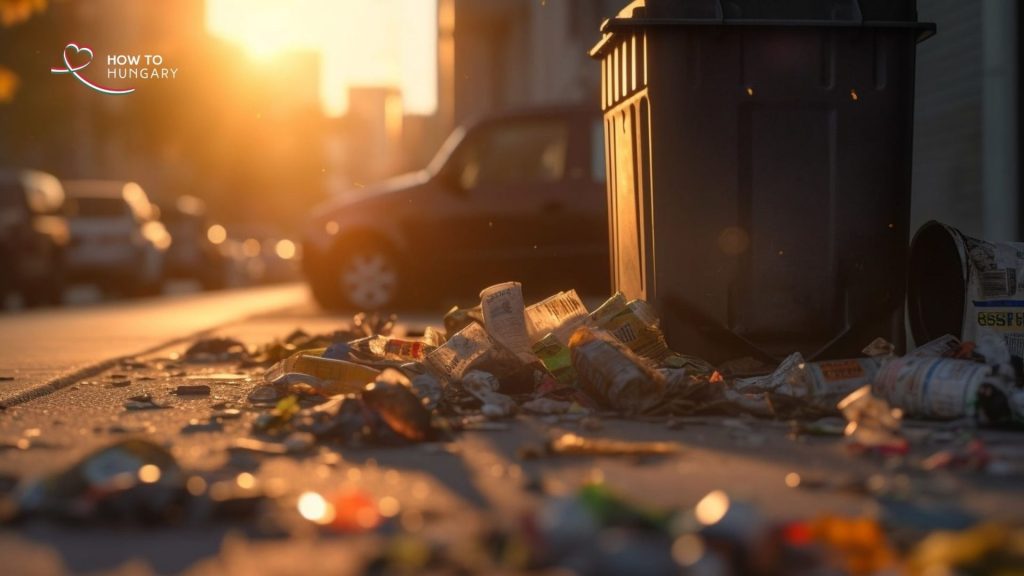
People now dig through public bins, communal bins, and apartment building rubbish rooms looking for bottles and cans worth HUF 50. Some pull bags apart and leave the rubbish behind. Residents, caretakers, and street cleaners then deal with the mess.
This happened in my mother’s building. People entered the building without permission, searched through the bins, and left rubbish across the floor. That is not a small inconvenience. It creates hygiene concerns, security concerns, and yet another job for people already dealing with Budapest’s daily building maintenance.
The machines create their own problems. They reject eligible containers when barcodes are damaged or labels have peeled. They fill up and stop working until staff empty them. They expect bottles to arrive clean and capped. Many consumers only discover that detail when the machine refuses their bottle.
So yes, REpont has changed behaviour. It has also created new problems around rubbish, building access, hygiene, and public space. As of late 2025, 47 settlements across Hungary still had no REpont location at all.
The MOHU App
The MOHU app is useful if you know it exists. It can locate your nearest return point, show real-time availability, and manage your digital balance. But not everyone is comfortable with apps, and the people using these machines most – older residents, people watching every forint, and those collecting bottles as supplementary income – are not always the digitally fluent audience the system seems to assume.
In Budapest, the problem is usually not finding a REpont machine. It is finding one that is working, empty, and not being guarded by a queue of people with carrier bags full of bottles. In the countryside, the issue can be more basic: distance. If the nearest reliable return point is a car journey away, the HUF 50 deposit becomes less of a neat recycling incentive and more of a small logistical negotiation.
The Retailer Problem Nobody Talks About
The friction goes deeper than broken machines. Hungary’s National Trade Association, OKSz, has been raising concerns since the system launched, and their complaints are substantive.
From September 2025, MOHU unilaterally cut the handling fee paid to large retailers – the supermarkets, hypermarkets and discounters that process between 70 and 80% of all returned containers – from HUF 7.5 to HUF 3.5 per item. At the same time, MOHU raised fees for smaller shops, which handle a fraction of the volume. OKSz estimated the combined change would add HUF 6.5 billion in additional costs to its members, who were already running the return service at a financial loss. MOHU announced the changes with a press release celebrating the higher rates for small retailers. The cut to large retailers went unmentioned.
Head of OKSz
Tamás Kozák, head of OKSz, told the Budapest Business Journal that the fee change had been “dictated”: no negotiations, no independent cost assessment, just a new schedule presented as settled. He also alleged that MOHU had failed to carry out required annual deep cleaning of its machines in more than half of cases. The machines, already undersized for the volume they are handling, are overburdened and under-maintained. When they break down, the retailers’ own staff manage the consequences.
Large retailers are in a bind. Because they sell beverages, they are legally required to host return machines. They cannot opt out. MOHU, as the sole concessionaire, sets the fees they receive for doing so. The mechanism in Hungarian law that was supposed to provide independent cost assessment for these fees, according to Kozák, simply does not work.
The Collectors Nobody Expected
Hungary’s bottle return system REpont has created a bottle-collecting economy that the launch materials barely acknowledged. When machines break or queues grow, some people give up and throw deposit bottles into ordinary bins. Others search those bins for containers worth HUF 50 each.
This has become one of the more uncomfortable public conversations around REpont. Some reports and online comments now describe bottle collectors as “scavengers”, which shows how tense the issue has become. But the real problem is not the label. It is the mess, hygiene risk, building security, and extra work left behind.
When people open communal bins or pull rubbish bags apart, residents and cleaners deal with the consequences. In Budapest apartment buildings, this can mean rubbish rooms left dirty, doors being propped open, strangers entering shared spaces, and more concern about rats or pests. Hungary’s bottle return system REpont did not create poverty, but it has made one part of it much more visible.
Sociologist Andrea Szabó has described this as the surfacing of something Hungary had been politely ignoring: many wages and pensions do not cover the real cost of living.
The Bottle Is Small. The System Around It Is Not.
Germany has lived with a similar reality for years. Its Flaschensammler, or bottle collectors, became part of public life after Germany introduced its own deposit system. Some German cities responded with bottle rings near bins, so people could leave containers for collectors without forcing them to search through rubbish.
In Budapest, some residents now do this informally. They leave bottles beside bins instead of inside them. It is not policy. It is people trying to reduce the mess.
Coming from Canada, the basic idea of bottle deposits does not surprise me. What feels different in Hungary is the way REpont sits inside supermarket routines, app use, retailer obligations, apartment building life, and a larger political argument about concessions. The bottle is small. The system around it is not.
The Clock Is Ticking
MOHU now has two problems, and neither can be fixed by putting a new sticker on the machine. The first problem comes from EU law. From January 2029, EU Regulation 2025/40 requires deposit return systems to meet stricter rules. Operators must usually be non-profit organisations focused only on bottle return. That creates a problem for MOHU. It belongs to MOL, a for-profit energy company. It also runs much more than Hungary’s Bottle Return System REpont.
There is one possible escape route. If Hungary reaches a 90% return rate by the end of 2028, MOHU may be able to continue. Right now, Hungary sits at about 80%.
MOHU also receives the HUF 50 deposit upfront from manufacturers. When people do not return bottles, MOHU keeps that money for operating costs. That does not mean the company wants people to give up. But it does create an awkward incentive inside a system that legally needs higher return rates.
Why the MOHU Review?
The second problem is political. Hungary’s new government, led by Prime Minister Péter Magyar, says it wants to review the MOHU waste management concession.
That matters because MOHU received a 35-year monopoly under the previous government. The new administration has also announced a National Asset Recovery and Protection Office. Its role is to examine major concession deals made under the previous administration. The question is simple: should one private company control such an essential part of Hungary’s waste system for 35 years?
Retailers are frustrated. Consumers are annoyed. EU rules are tightening. Hungary’s bottle return system REpont now sits at the centre of all three problems.
FAQ

Anikó Woods is a Canadian-Hungarian writer, technology specialist, and digital strategist who swapped Toronto traffic for Hungarian bureaucracy. She’s the creator of HOW TO HUNGARY: Budapest & Beyond. Since moving to Hungary in 2017, she’s been deep in the paperwork trenches – fact-checking, interviewing experts, and helping others make sense of the madness. Her writing turns chaos into clarity, with a few laughs (and wine recommendations) along the way.
0 Comments