
If you’re paying for parking in Budapest this summer, there are two important changes that will affect both how much you pay and how you pay. From 1 July 2026, Budapest has officially removed cash payments at its on-street parking ticket machines, meaning all parking sessions must now be started electronically using a mobile app, SMS or another approved mobile payment method.
At the same time, parking fees have also increased across the city, with some zones seeing rises of between 33% and 50%.
The changes affect anyone using paid on-street parking in Budapest, whether you live here, you’re visiting for a weekend or you’ve hired a car while exploring Hungary. The timing is particularly relevant as Budapest heads into another busy tourist season and one of Europe’s hottest summers on record. The last thing anyone wants is to pull into a parking space, discover the ticket machine is no longer accepting payments and then realise the hourly rate has also gone up.
Fortunately, once you know how the new system works, paying for parking in Budapest is still quick and straightforward.
At a Glance
- Parking fees increased: Many Budapest parking zones saw hourly rates rise by approximately 33–50% from 1 July 2026.
- No more cash payments: Municipal on-street parking ticket machines no longer accept cash.
- Mobile payment only: Parking must now be started using a mobile app, SMS or another approved phone payment service.
- Resident permits: No changes to residential parking permits or eligibility.
- Private car parks: This only affects Budapest’s municipal on-street parking. Private operators may use different payment methods and tariffs.
Why has Budapest Removed its Parking Machines?
This isn’t simply a technology upgrade. According to Budapest, around 90% of drivers were already paying electronically, making the remaining ticket machines increasingly expensive to maintain for a relatively small number of users.
Rather than continue operating both systems, the city has moved entirely to mobile payments for municipal on-street parking.
That means:
- Parking ticket machines no longer accept payment.
- Cash payment for on-street parking has ended.
- Every parking session must now be started electronically.
It’s worth noting that this change only applies to municipal paid parking spaces. Private car parks, shopping centres, hotels and other operators may continue to use their own payment systems.
How Much Does Parking Cost in Budapest?
Parking charges also increased on 1 July 2026, with some zones seeing hourly rates rise by around 33% to 50%. The exact amount you’ll pay depends on where you park, as Budapest’s parking fees are set by zone rather than a single city-wide rate.
Before leaving your vehicle, always check the parking sign for the current hourly rate, operating hours and any maximum parking time. If you haven’t parked in Budapest for a while, don’t assume you’ll be paying the same amount as last year.
How Do You Pay for Parking in Budapest?
Although the payment method has changed, the parking process itself remains much the same.
1. Check the parking zone
Before starting your parking session, look for the parking information sign nearest your vehicle. Every paid parking area has its own zone code, which you’ll need when paying by app, SMS or phone. Parking fees, operating hours and maximum parking times can also vary depending on the zone.
2. Choose your payment method
Budapest currently allows three ways to start parking:
- Mobile app
- SMS
- Telephone call
The city has added QR codes to help drivers find supported payment options more quickly.
Which Parking app Should You Use?
There are several approved parking providers, and the QR code on the parking sign will direct you to available options.
Our Experience: Andrew has always used the Simple app whenever we’ve needed paid parking outside our residential district. Once you’ve registered your vehicle, starting and stopping parking takes only a few seconds, and it’s much easier than walking back to a machine if your plans change. Parkl is another popular option used by many drivers in Hungary.
If you visit Budapest regularly, it’s worth downloading and setting up your preferred app before you actually need it. That small bit of preparation can save a surprising amount of time, especially if you’re trying to park on a busy street or during the current heatwave.
What do Foreign Visitors Need to Know?
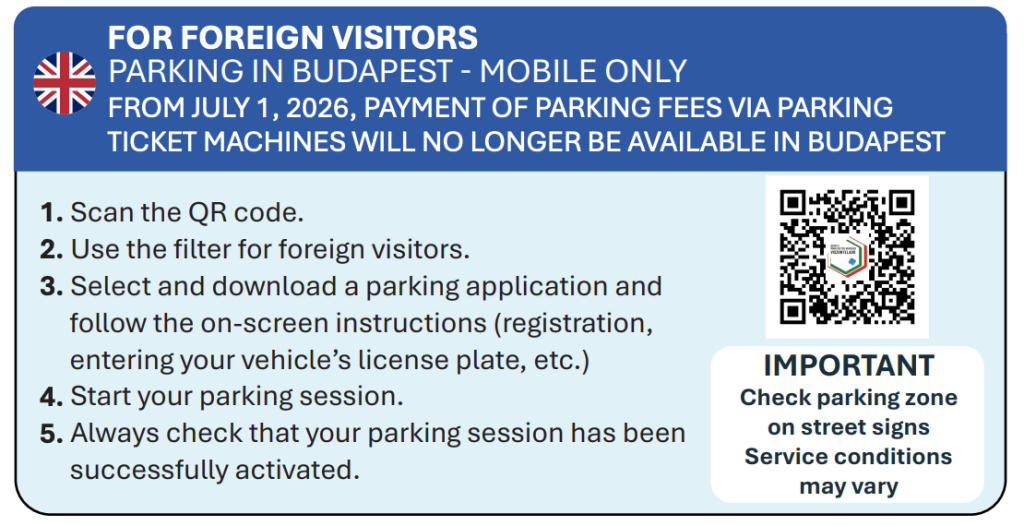
If you’re visiting Budapest from abroad, you can still use the parking system even if you’ve never driven here before.
The city recommends the following process:
- Scan the QR code displayed on the parking sign.
- Select the option for foreign visitors.
- Download one of the supported parking apps.
- Register your vehicle.
- Start your parking session.
- Always check that your parking has successfully started before leaving your car.
This is particularly important if you’re driving a rental car or using a foreign mobile number for the first time.
Does This Affect Residents?
No. If you already have a residential parking permit for your district, nothing changes. For example, we have a residential permit for our district in Budapest, so we only pay for parking when we’re elsewhere in the city. Resident permits, eligibility and parking rights remain exactly the same. The only change is how drivers pay when using chargeable parking spaces.
A Few Practical Tips
Although the new system is designed to be simple, there are a few things I’d recommend. Download your preferred parking app before you leave home rather than waiting until you’ve found a parking space. Make sure you’ve entered your licence plate correctly. Double-check that your parking session has actually started before walking away.
If you’re travelling during this week’s extreme heatwave, it’s also worth keeping your phone charged. Since parking is now entirely mobile, a flat battery could quickly become more than just an inconvenience.
If you’re relying on mobile data from another country, make sure your connection is working before leaving your vehicle. Since parking must now be started electronically, it’s much easier to resolve any connection issues before walking away.
Frequently Asked Questions
Can you still pay cash for parking in Budapest? No. Paying for parking in Budapest is now mobile-only for municipal on-street parking. From 1 July 2026, cash payments at parking ticket machines were discontinued, so drivers must use a mobile app, SMS or another approved electronic payment method.
How do you pay for parking in Budapest? Paying for parking in Budapest starts by checking the parking zone shown on the nearest street sign. You can then start your parking session using an approved mobile app, SMS or a supported phone service. The QR codes on parking signs also help drivers find the correct payment option.
Can tourists still pay for parking in Budapest? Yes. Visitors can pay for parking in Budapest using the same electronic payment methods as residents. The easiest option is to scan the QR code on the parking sign, download a supported parking app, register your vehicle and confirm that your parking session has started before leaving your car.
Do Budapest residents need to do anything differently? No. If you already have a valid residential parking permit, nothing changes. You only need to pay electronically when parking outside your permitted area or in another paid parking zone where your resident permit does not apply.
Does this change apply to private car parks? No. The new rules only apply to Budapest’s municipal on-street parking. Private car parks, shopping centres, hotels, hospitals and airports operate their own parking systems and may continue to accept cash, cards or other payment methods.
Driving in Hungary Made Easier
Whether you’re visiting Budapest for a few days or settling into life in Hungary, understanding the local driving rules can save you time, money and unnecessary stress. If you found this guide helpful, you might also like my other articles covering topics such as driving licences, importing and registering a vehicle, insurance, road tolls and other practical advice for motorists in Hungary.
For a complete guide, my HOW TO HUNGARY ebook brings everything together in one place. It includes dedicated chapters on driving licences, buying and importing a vehicle, registration, insurance, parking rules and fees, mandatory inspections, motorway tolls and much more, alongside over 70 other topics designed to help you settle into life in Hungary with confidence.

Anikó Woods is a Canadian-Hungarian writer, technology specialist, and digital strategist who swapped Toronto traffic for Hungarian bureaucracy. She’s the creator of HOW TO HUNGARY: Budapest & Beyond. Since moving to Hungary in 2017, she’s been deep in the paperwork trenches – fact-checking, interviewing experts, and helping others make sense of the madness. Her writing turns chaos into clarity, with a few laughs (and wine recommendations) along the way.
Don’t forget to “Stop Parking” on the app or your 20 minute stay can cost the maximum!