
Updated November 2026. What changed this year: building costs are expected to rise 5 to 6% in 2026, and a new energy renovation grant announced on 19 October could cover up to half the cost of some projects from 2027.
You have the keys, a folder of Pinterest boards and three quotes that look nothing alike. Renovating in Hungary in 2026 costs roughly 160,000 to 380,000 Ft per square metre (about €410 to €975) for a full job with materials. A Budapest flat can be finished in 8 to 12 weeks with serious planning, or drag on for three to six months without it. The quote is where the negotiation starts, not where it ends. When we renovated our first Budapest flat, we did not even know which shops sold what.
Since 2017 I have been through three renovations in Hungary: our Budapest flat, my sister’s Budapest flat and our wine house in the Balaton Highlands. My husband Andrew has spent more than 40 years in construction, designing smart homes, and I worked alongside him in his business for years. I checked the figures below on 6 November 2026 against contractor price guides, Bankmonitor, ÉVOSZ and Hungary’s national building rules, with renovation project manager Stephen Saracco.
What Renovating in Hungary Costs in 2026
Renovating in Hungary costs 35,000 to 80,000 Ft per square metre for a cosmetic refresh and 160,000 to 380,000 Ft for a full renovation, with materials included. Budapest typically runs 15 to 25% above smaller towns. Furniture, kitchen appliances and design fees usually sit outside these figures.
| Scope | Ft per m2 (2026) | Approx. € per m2 |
|---|---|---|
| Cosmetic: paint, small repairs, maybe floors | 35,000 to 80,000 | €90 to €205 |
| Partial: tiling, some plumbing and wiring, windows | 90,000 to 200,000 | €230 to €510 |
| Full: plumbing, wiring, kitchen, bathroom | 160,000 to 380,000 | €410 to €975 |
| Full, labour only (you buy the materials) | 150,000 to 320,000 | €385 to €820 |
Sources: Építcentrum and Barabás Kft. 2026 price guides (both contractor sites, so treat them as the trade’s own view); ÉVOSZ via Economx, March 2026.
A full renovation of a 50 m2 flat lands between 8 and 19 million Ft (about €20,500 to €49,000). And prices are moving up, not down. ÉVOSZ expects building costs to rise 5 to 6% this year, while around 20,000 more construction workers retire than join the trade.
Stephen Saracco, a renovation project manager who has been running construction projects in Budapest for two decades (more on him below), sees the same budget mistakes again and again: no contingency, no structural assessment, and “treating the contractor’s quote as the total budget”
Why No Two Hungarian Quotes Match
Two Hungarian renovation quotes can show almost the same number per square metre and describe completely different jobs. One builder’s 200,000 Ft includes the tiles, the pipes and the bathroom suite. Another’s 200,000 Ft covers only labour, and you go shopping for everything else.
Ask four questions about every quote:
- Labour only, or labour and materials? In Hungarian, look for anyaggal (with materials) or csak munkadíj (labour only).
- Nettó or bruttó? A nettó price excludes VAT. Renovation work generally carries Hungary’s standard 27% VAT, so a 10 million Ft nettó quote becomes 12.7 million Ft. The reduced 5% rate is for new homes, not renovations.
- What sits outside the price? Design, waste removal, appliances and site cleaning are common exclusions.
- Who buys what, and when? If you buy the materials, a late tile delivery becomes your delay, not the builder’s.
Stephen’s fix is to stop comparing prices and start comparing specifications. “Getting an apples to apples comparison means having a clear, standard scope of work in a uniform format,” he says.
How Long It Really Takes
Contractor websites quote 6 to 12 weeks for a full flat renovation. Bankmonitor puts it at three to six months, with hidden faults found mid-job. Stephen’s answer sits in between, and it depends almost entirely on what happens before the first wall comes down.
“With strong planning and clear pre-construction prep, an 80 m2 flat renovation in Budapest can take between 8 and 12 weeks,” he told me. He once promised six to eight weeks and finished about fifty flats on that schedule. “But we did a massive amount of planning.”
A typical Budapest flat renovation runs in this order:
- Survey and drawings, plus a structural engineer’s opinion (statikai szakvélemény) where walls or floors change.
- Building consent. In a block of flats (társasház), work touching the common parts of the building can need the owners’ approval, such as moving a bathroom whose pipes run through the floor slab or removing walls. Ask your common representative (közös képviselő) before you plan it.
- Quotes and contract.
- The works. In older buildings, opening a wall often changes the schedule.
Fluent Hungarian Won’t Help on a Building Site
Speaking Hungarian is not the same as speaking builder Hungarian. Site vocabulary and an unspoken sense of what is “normal” leave even native speakers feeling like outsiders.
I say this as someone with every advantage. Andrew has worked in construction his entire career and is the handiest person I know. He renovated almost all of our Balaton wine house with his own two hands. And still, every one of our three renovations was a struggle.
My own Hungarian vocabulary is limited, and builder Hungarian is another language altogether. When I got stuck, I would call my parents, who speak Hungarian fluently. Often they did not know the word either. Procurement, the endless finding, comparing, ordering and chasing, is the part I hate most, and it is the part nobody puts in a quote. These days Andrew says he has one more full renovation left in him. That is a professional talking.
The Mezzanine Nobody Could Explain
Our first Budapest flat had a mezzanine, the galéria that classic Budapest flats tuck under ceilings around 4.5 metres high. Coming from Canada, where building codes cover almost everything, we were shocked when nobody could tell us the rules for reworking it.
The rules exist. Hungary’s national building rulebook, known as TÉKA (Government Decree 280/2024), defines a galéria precisely. It can cover no more than 50% of the room’s floor area. It must be a partial intermediate level, it cannot contain a separately enclosed room, and its solid parapet cannot be higher than 1 metre.
Before building one, check for four things: the building’s load-bearing capacity, whether a building-authority procedure applies, whether the társasház must consent, and whether district heritage or conservation rules apply.
Hungary is also not a DIY culture in the way Canada, the UK or the US are. There is OBI, but people call a professional. Four areas legally need one, Stephen says: electrical, gas, structural and chimney work.
Who Is Checking the Builder?
Most people renovating in Hungary do not need another contractor. They need someone on their side of the table. Stephen names the gap plainly.
“Owners sometimes rely entirely on the contractor to report progress, assess variations and confirm the quality of completed work,” he says. “This creates a potential conflict of interest: the person reporting the cost increases may also be the person benefiting financially from them.”
Meet Stephen Saracco
I have known Stephen for years. Our paths keep crossing through the Irish Hungarian Business Circle, where we are both members. He is an American who has lived in Hungary since the nineties. Fluent in Hungarian and English, he is exactly the bridge this post is about. For half his career he worked as a general contractor, the builder himself, and he still does: he built one of the English Garden buildings. He also works as an owner’s project manager, the person on your side of the table who coordinates the architect, specialists and crews, and keeps the budget, schedule and conversations on track. Having been the builder, he knows exactly what to check.
Most of his work is new builds and full renovations, and his past clients range from the Canadian Embassy in Budapest to banks such as Citibank and Erste. He can step in at any stage, from before you buy to a project already running late. As Capital Transactions Advisor for RE/MAX Hungary, he is used to sizing up refurbishment costs before a purchase. He prefers working in Pest “but nothing is off limits”, Balaton included.
On larger projects with a clear scope, project management is usually charged as a percentage of the project value, typically 4 to 8%, or a minimum fixed fee. Home renovations vary more, so the easiest way to get a number is to send him the details below.
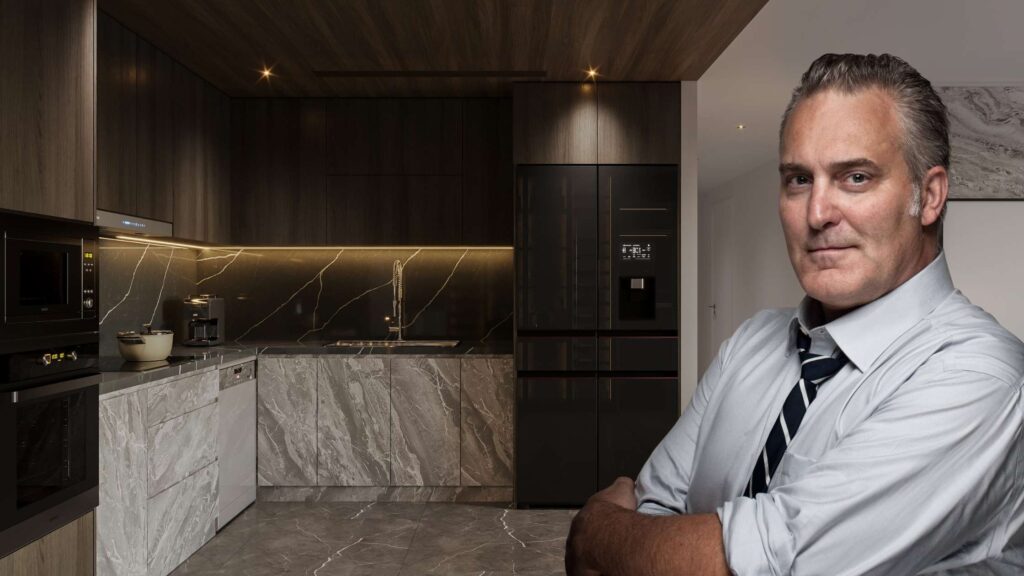
Stephen Saracco, fluent in Hungarian, English and builder.
Stephen’s Five Checks Before You Sign
“I always check that the contract scope of works matches the priced quotation, line by line,” Stephen says. Most disputes, he explains, start not with overcharging but with owner and builder understanding the price differently. His pre-signature test:
- Scope: is every item described, including demolition, disposal, making good and finishing?
- Exclusions: what is left out, including provisional sums and owner-supplied materials?
- Specification: are materials, brands, quality standards and dimensions defined?
- Variations: must you approve extra costs in writing before work goes ahead?
- Payments: are they tied to verified completed work, not the builder’s cash flow?
Before You Call Him
Send Stephen the basics first: the property’s location and size, whether it is a flat or a house, what you want done with photos or drawings, your budget and timing, and whether you will be in Hungary during the works.
Contact: Stephen Saracco, Saracco International Bt.
Email: sa******************@***il.com
Phone: +36 30 940 4224
He is also listed on my Trusted Experts page.
Related Reads and Helpful Resources
- Közös Költség: Common Costs in Hungary explains the common representative you will need on side for structural work.
- Otthon Start Is Out. Here Is What Wekerle Plusz Changes covers the new energy renovation grant and 3% loan.
For the rules, the Condominium Act (2003. évi CXXXIII. törvény) is on njt.hu, and NAV covers VAT.
Questions People Actually Ask
How much does it cost to renovate a flat in Budapest?
A full renovation of a Budapest flat costs roughly 160,000 to 380,000 Ft per square metre in 2026 (about €410 to €975), with materials included. For a 50 m2 flat, that is 8 to 19 million Ft (€20,500 to €49,000). Furniture, appliances and design fees are usually extra.
Can I do renovation work myself in Hungary?
Cosmetic jobs such as painting are usually fine to do yourself. Electrical, gas, structural and chimney work need licensed professionals, and changes to a flat’s structure or shared pipes need the building’s consent. Most owners here hire a professional.
Do I need permission to renovate a flat in a Hungarian apartment building?
Cosmetic work inside your own flat usually needs no approval. Work that affects the building’s common parts, such as moving bathroom pipes through the floor slab or removing walls, can need the owners’ consent. You may also need drawings and a structural engineer’s opinion. Ask your common representative first.
Can I manage a renovation in Hungary from abroad?
Yes, but it is hard without someone on the ground. Site decisions and problems found mid-job need fast answers, usually in Hungarian. An owner’s project manager can represent you locally, check the builder’s reports and keep the budget on track.
The Flat My Parents Didn’t Buy
My parents once walked away from the flat they really wanted. It needed a full renovation, and the thought of managing it scared them off, so they bought a different one instead. None of us knew that services like Stephen’s even existed: someone you could hire to sit on your side of the table and run the whole thing in Hungarian.
So here is my advice, from someone who has lived through more renovations than I care to count. There is no perfect season to start, so plan longer than feels necessary. Get every quote priced against the same list. Never let the person doing the work be the only one checking it. And if a new build or a big renovation is on your list for 2027, start lining up help before winter, so people know the work is coming.
If I could go back to that first flat, I would hand the procurement to someone who already knew the shops, the words and the order things happen in. Andrew can keep the tools.
And if you are still working out how anything in Hungary works, my ebook HOW TO HUNGARY: Budapest & Beyond covers the everyday systems I wish someone had explained to me in 2017.
Disclosure: Stephen is a HOW TO HUNGARY partner and is listed on my Trusted Experts page.
This is general information, not legal or financial advice.

Anikó Woods is a Canadian-Hungarian writer, technology specialist, and digital strategist who swapped Toronto traffic for Hungarian bureaucracy. She’s the creator of HOW TO HUNGARY: Budapest & Beyond. Since moving to Hungary in 2017, she’s been deep in the paperwork trenches – fact-checking, interviewing experts, and helping others make sense of the madness. Her writing turns chaos into clarity, with a few laughs (and wine recommendations) along the way.
0 Comments