
Updated July 2026. What changed this year: on 22 July 2026 the government confirmed it will not relax the rules. Those rules keep most below-grade spaces off the legal housing market, despite a tight supply of flats.
My first place after leaving home was a basement apartment in Toronto. Low ceiling, one window at ankle height, the landlord’s furnace for a roommate. A basement flat in Budapest works differently. Here you usually cannot legally live in a below-grade space at all. Hungarian building rules require a habitable room to have direct natural light and proper ventilation. As of July 2026 the government has confirmed it will not soften that standard. I learned the nuance the slow way, viewing a cheap “two bedroom” that turned out to have exactly one legal bedroom.
I have rented below grade in one country and spent three years watching my husband Andrew coax a derelict Balaton winehouse back to life in another, so I have seen what building authorities on both sides of the Atlantic will and will not sign off.
The bargain that usually is not one
A below-market basement flat in Budapest is cheap because the register often lists its lower level as storage or ancillary space, not a legal dwelling. That single line in the property register does real damage. It caps what you can do with the space, who will insure it, and who will lend against it. For context, central Budapest sold at roughly 1.7M HUF (4,790 euros) per square metre in Q3 2025. The MNB house price index rose about 21.3 percent year on year over the same period. When a flat sits well under the district average, the discount is rarely a gift. It usually means the register counts some of those square metres as something other than habitable.
Toronto trained me to read basements as normal. In much of Canada a finished basement suite is a legitimate, rentable, often legal rung on the housing ladder. Budapest does not share that assumption, and the gap catches new arrivals out.
| Below-grade living | Toronto | Budapest |
|---|---|---|
| Typical legal status | Common, frequently permitted as a secondary suite | Rarely a legal habitable dwelling |
| Natural light rule | Often met with egress windows and light wells | Direct natural light required, strictly interpreted |
| Ventilation | Mechanical systems widely accepted | Natural ventilation expected, mechanical not treated as equal |
| Usual classification | Living space | Storage, cellar, or ancillary room |
| Effect on price | Adds usable value | Signals a discount and a lending problem |
Table figures describe general practice, not a specific address. Confirm any flat’s classification in the land register before you rely on it.
What a legal basement flat in Budapest needs
A legal basement flat in Budapest needs every habitable room to meet the national building code. Hungary’s national building code, known as OTÉK (Országos Településrendezési és Építési Követelmények, Government Decree 253/1997), sets standard rules for zoning, land use, and structural design. It is being phased out in parallel with the new TÉKA regulations under the Hungarian Architecture Act until mid-2027. That means direct natural light, an openable window to outside air, adequate ceiling height, and damp protection. The district building authority signs off each one. Miss a single requirement and the room is legally not a room. It becomes storage with ambitions.
The sticking point in 2026 is ventilation. Modern building technology can now light and ventilate a lower level mechanically. It would satisfy a Toronto inspector without blinking. Hungarian regulation still asks for direct window openings and natural airflow, and rejects mechanical systems as an equal substitute. On 22 July 2026, the responsible ministry confirmed it has no plans to change that. It argues the current framework is adequate, and that converting these spaces would strain local parking and infrastructure. Housing analysts noted the same rules keep thousands of potential units off the market.
When a cellar can become a legal room
Say you want to convert a cellar or semi-basement into legal living space. The route runs through the district building authority and ends with an occupancy permit, the használatbavételi engedély. Budget for a real project, not a weekend. Our Balaton renovation took three years. A winehouse is its own particular saga, but it taught us one thing. Hungarian building sign-off rewards patience and punishes assumptions.
The szuterén trap in property listings
The most common mistake is trusting the room count in a listing. Hungarian estate ads will happily describe a below-grade room as a bedroom. Legally it might be a szuterén, a semi-basement space, or a raised ground floor that is not quite either. The photos look fine. The floor plan looks generous. The register tells a quieter story.
This is where my cheap “two bedroom” fell apart. The second bedroom sat half a level down, with one small window facing an internal light well. The register recorded it as ancillary space. Liveable in practice, not lettable or mortgageable in law. A bank valuer will strip that room out of the usable area. An insurer may query a claim. A future buyer’s lawyer will find exactly what mine did. If a price looks too good for the district, ask for the tulajdoni lap, the title deed. Read how it classifies each room before you fall for the light fixtures.
Related reads and official sources
For the wider housing picture, these pair well with this post:
- Budapest Rental Market: What to Expect
- Understanding Kozos Koltseg: Common Costs in Hungary
- Presshouses and the Joys of Rural Hungary
Official source: the national building requirements (OTEK) are published on the Nemzeti Jogszabalytar at njt.hu.
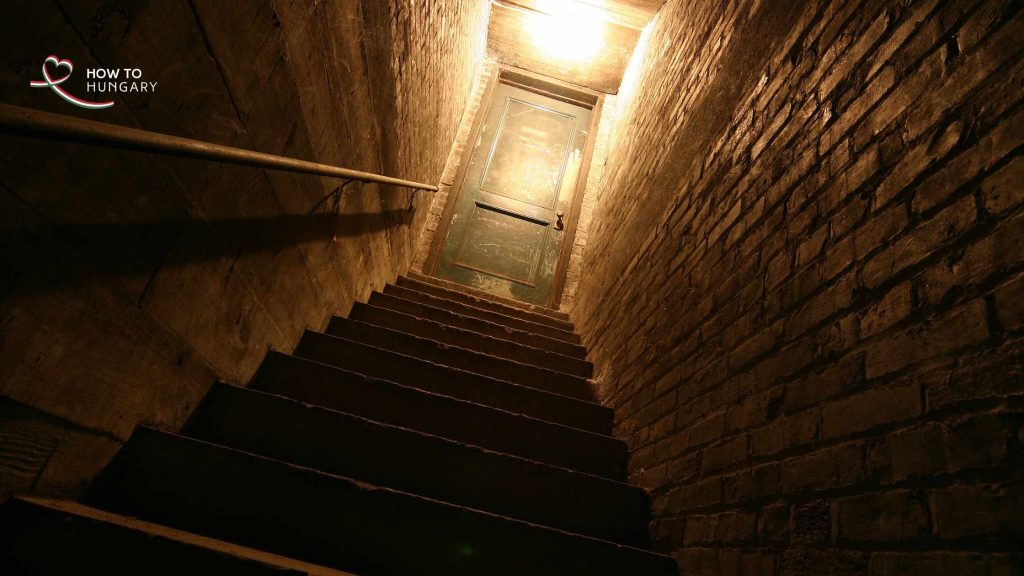
Atmospheric in a photo, a fire-code conversation in person. One bulb, no window, and the kind of below-grade space Hungarian rules will not sign off as a habitable room.
Questions I get asked about basement flats
Can you legally live in a basement flat in Budapest?
Usually not, unless the space carries an official registration as a habitable dwelling. Hungarian rules require each living room to have direct natural light, proper ventilation and adequate ceiling height. The district building authority verifies it. Many below-grade rooms count as storage or ancillary space instead. You can occupy them informally, but you cannot rely on them as legal, insurable, mortgageable living area. Always check the title deed before you assume a room counts.
What is the difference between a szuterén and a raised ground floor?
A szuterén sits partly below street level. The rules treat it as a semi-basement, which usually fails the habitable-room test. A raised ground floor, magasföldszint, sits slightly above street level and generally works as legal living space. Listings blur the two because one sells better than the other. The land register is the only source that settles which one you are actually buying.
Why will not the government just allow basement conversions?
As of 22 July 2026 the responsible ministry says the current framework is adequate. It will not relax the rules. Its reasoning: easing the light and ventilation rules would add pressure on local infrastructure and parking. Modern technology could make many of these spaces comfortable, but that has not moved the ministry. Housing analysts argue the position keeps thousands of potential flats out of a tight market.
Does a cheap basement flat affect getting a mortgage?
Yes. If the register does not list part of the flat as habitable space, a bank valuer will usually exclude that area from the usable square metres. That lowers the valuation and the loan you can secure against it. Insurers may also treat unregistered living space as a risk. This is why a discount that looks like a win can quietly shrink your financing before you reach the notary.
The view from below
I have a soft spot for basements. My Toronto one was cold, a little grim, and exactly what I could afford at twenty. It did its job. Budapest simply files them differently. After nearly a decade here I have stopped fighting that and started reading the register first. If you are flat hunting into the autumn, treat a suspiciously cheap lower-level flat as a question, not a bargain. Get the classification confirmed before you fall for the parquet.
If you want the longer version of how Hungarian property, paperwork and daily life actually fit together, my ebook walks through the lot, mistakes included.

Anikó Woods is a Canadian-Hungarian writer, technology specialist, and digital strategist who swapped Toronto traffic for Hungarian bureaucracy. She’s the creator of HOW TO HUNGARY: Budapest & Beyond. Since moving to Hungary in 2017, she’s been deep in the paperwork trenches – fact-checking, interviewing experts, and helping others make sense of the madness. Her writing turns chaos into clarity, with a few laughs (and wine recommendations) along the way.
0 Comments