
Checked November 2026. Rules, dates and fines checked for the 2026/27 winter season.
Every November, Andrew drives to Porsche Buda and comes home with a set of summer tires that move in with us until spring. I have opinions about this. Here is the short answer to the question that lands in my group every autumn: winter tires in Hungary are not mandatory for private cars. There is no fixed date and no general fine, and snow chains are compulsory only where a road sign says so. The catch is elsewhere. Your insurer can look at your tires after a winter crash, and Austria’s 1 November rule starts about 170 kilometres from Budapest.
We have had a car in Hungary since 2020. Andrew does the driving here, and we both drove through Toronto winters before that. The rules, fines and prices below were checked on 12 November 2026 against the sources linked in each section.
| Country | When winter tires are required | Minimum tread | Fine |
|---|---|---|---|
| Hungary | No general requirement. Chains only where signed. | 1.6 mm (legal minimum for any tire) | None for tires alone |
| Austria | 1 November to 15 April, in winter conditions | 4 mm | From €35, up to €5,000 if you endanger others |
| Slovakia | Whenever snow, ice or frost is on the road | 3 mm, on all wheels | From about €50 |
| Slovenia | 15 November to 15 March | Not specified | €40 |
| Croatia | 15 November to 15 April on designated roads | 4 mm if using summer tires plus chains | €130 |
| Czechia | 1 November to 31 March, in winter conditions | 4 mm | Up to 5,000 CZK (about €200) |
| Romania | Year-round on snow or ice | Not specified | 1,946 to 4,325 RON (about €385 to €850), registration can be retained |
Neighbouring-country figures: winiety24.eu, a commercial vignette seller, current as of 7 November 2026. Rules change, so check the official source for your route before you leave.
Hungarian Law Asks for Less Than You Think
Hungary has never brought in a general winter tire requirement for private cars. You can legally drive through January on summer tires, provided the tread is at least 1.6 mm, the legal minimum in Hungary for any tire (Economx, October 2025). Experts recommend at least 4 mm on a winter tire, because grip in slush drops off well before the legal limit.
Snow chains work the same way. You do not have to carry them. When the road operator puts up a “snow chains compulsory” sign on a snowy stretch, you either fit chains or you do not drive that section. Authorities can also restrict specific roads to cars on winter tires or chains in bad weather.
One group does have a rule. Budapest taxis must run season-appropriate tires, which is a nice detail to remember the next time a cab slides past you on Andrássy út.
The Insurance Clause Nobody Reads in November
This is the part that surprises people in my group, and it is why “not mandatory” is not the same as “not your problem.” Hungary’s compulsory motor insurance (kötelező, or KGFB) pays for damage you cause to other people. It does not pay for your own car when you slide into a lamp post on black ice. That is casco’s job, if you have it.
Casco is where the tires can come back to bite. In June 2026, Pénzcentrum reported that insurers can examine a car’s tires after an accident, and that tires unsuited to the season may reduce the payout. No law requires winter tires, but an insurer can still argue that summer tires on ice contributed to the damage.
So the practical step takes ten minutes. Open your casco conditions (feltételek) and search for anything about the vehicle’s technical condition or tires. If the wording is vague, email your insurer and get the answer in writing before the first snow, not after.
Austria Starts 170 Kilometres From Budapest
Cross at Hegyeshalom (with your Hungarian motorway vignette sorted) between 1 November and 15 April and you are in a country where winter tires are required in winter conditions. Snow, slush or ice on the road counts. The basic fine is €35, but it can climb to €5,000 if you put other people at risk.
The detail that catches Hungarian-registered cars is tread depth. Austria treats a winter tire with less than 4 mm of tread as a summer tire. A set that is perfectly legal in Budapest at 3 mm can be non-compliant in Vienna.
Slovakia is stricter still in one way. It has no fixed dates for passenger cars, and the rule applies whenever there is snow, ice or frost on the road, or when it can be expected on your route. A day trip to Bratislava’s Christmas market in a cold snap counts. Czechia and Croatia work on dates, and Romania applies its rule year-round on snow.
If your winter plans include Vienna’s markets, a ski weekend in the Tatras or Christmas with family in Transylvania, the Hungarian rule stops mattering the moment you cross the border.
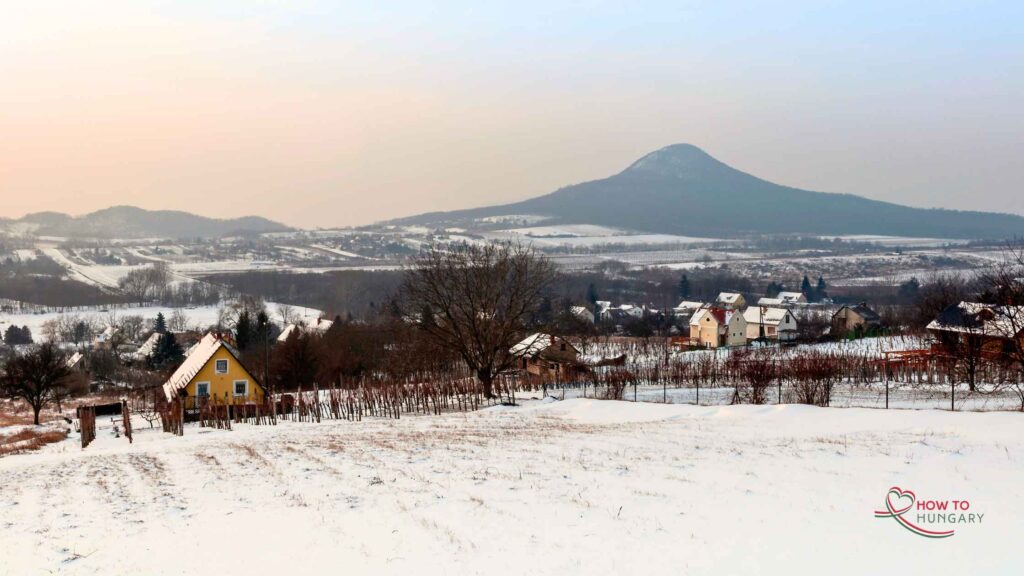
The Balaton Highlands in winter. The vines are sleeping, and so is our car.
What Andrew Pays at Porsche Buda
Andrew has swapped our tires every spring and autumn since we bought the car. Porsche Buda does all our servicing, and when we bought the car the advice was simple: change them each season. We assumed that was the law. It turns out it was just good advice.
A swap without storage costs us about 20,000 HUF (about €55). We could pay extra for a gumihotel, where the shop stores your off-season set. We do not. Our tires live at home, a choice I have made my peace with only in the legal sense.
Timing follows the 7°C rule that tire makers have used for years. Winter compounds are softer. Once the asphalt stays above roughly 7 to 10°C, they lose stability, wear quickly and use more fuel. Pénzcentrum reports that a car on winter tires in warm weather can need 3 to 5 metres more to stop from 50 km/h. In practice that means late October or early November for the switch, and an eye on the forecast at Easter.
Prices vary by shop, wheel size and whether you book before the first-frost rush. Booking a week ahead in October is far easier than calling the morning after the first snow, when every gumiszerviz in Buda has a queue.
Toronto Never Required Them Either
This is the part I still find funny. In Toronto, Andrew and I both drove on all-season tires through real Canadian winters. Ontario has never required winter tires. Instead, since January 2016, Ontario insurers have had to offer a discount to drivers who fit them, usually up to 5%. Quebec, next door, makes them mandatory from 1 December to 15 March.
So we arrived in a country with milder winters than Toronto and started changing tires twice a year for the first time in our lives. Ontario rewards you through your insurer for fitting them. Hungary, it turns out, can penalize you through your insurer for not fitting them.
When this set wears out, we may to switch to all-seasons. We close up the Balaton house for the winter, so there are no icy hill roads up to the winehouse in January, and we are not driving to Austria in February. Pénzcentrum describes all-season tires as a fair compromise for drivers who cover under about 10,000 km a year, mostly in the city. That describes our winter driving pretty well.
Andrew is not fully convinced. “I’d rather have dedicated summer tires every time,” he says. “Better fuel mileage. With all-seasons, we lose some.” He is right that you pay a little at the pump for the convenience. For me, losing a stack of tires from our house is worth it.
Related Reads
- 2026 Hungarian Motorway Vignettes: Prices, Changes and Savings: you need one before the drive to the border, and the 2027 prices are worth checking now.
- Hungary Driver’s Licence 2025: What It Costs: if you are still driving on a foreign licence, start here.
- Paying for Parking in Budapest: the other winter driving cost nobody budgets for.
- Official: KRESZ on njt.hu [PLACEHOLDER: direct link], and the ÖAMTC for Austria’s current rules [verify page].
FAQ
Are winter tires mandatory in Hungary? No. Hungary has no general winter tire requirement for private cars, no fixed date and no fine for summer tires alone. Budapest taxis are the exception. Your tires still need at least 1.6 mm of tread, and authorities can close specific roads to cars without winter tires or chains in severe weather.
Do I have to carry snow chains in Hungary? No. You only need to fit them where a road sign makes chains compulsory on a snowy section. If you do not have them, you cannot use that stretch. Austria, Croatia and Slovakia are different, so check before any winter trip across the border.
Will my insurance pay if I crash on summer tires in winter? Your compulsory insurance (KGFB) covers damage to others either way. Casco covers your own car, but insurers can inspect the tires, and Pénzcentrum reported in June 2026 that unsuitable tires may reduce a payout. Check your casco conditions or ask your insurer in writing.
How much does a tire swap cost in Budapest? We pay about 20,000 HUF (about €55) for a swap at our dealership, without storage. Prices depend on the shop and wheel size. A gumihotel, where the shop stores your off-season tires, costs extra but keeps them out of your flat.
One Last Drive to the Balaton
Next week Andrew drives us down to the Balaton one last time this year, to close up the winehouse for the season. I will be in the passenger seat, as I always am here, watching the vineyards turn bare and the lake go grey. Then the house sleeps until spring, and the car goes back into the garage. In Budapest we barely touch it, because the trams and metro get us everywhere faster.
That is the funny thing about winter here. It asks far less of us than Toronto ever did, and we still prepare as if a blizzard is coming. If you are still working out the rest of life in Hungary, the paperwork, the healthcare and the language, that is exactly why I wrote HOW TO HUNGARY: Budapest & Beyond.
No partnerships or fees are connected to this post. Porsche Buda is simply where we service our car.

Anikó Woods is a Canadian-Hungarian writer, technology specialist, and digital strategist who swapped Toronto traffic for Hungarian bureaucracy. She’s the creator of HOW TO HUNGARY: Budapest & Beyond. Since moving to Hungary in 2017, she’s been deep in the paperwork trenches – fact-checking, interviewing experts, and helping others make sense of the madness. Her writing turns chaos into clarity, with a few laughs (and wine recommendations) along the way.
0 Comments